Enquiry-based learning in practice

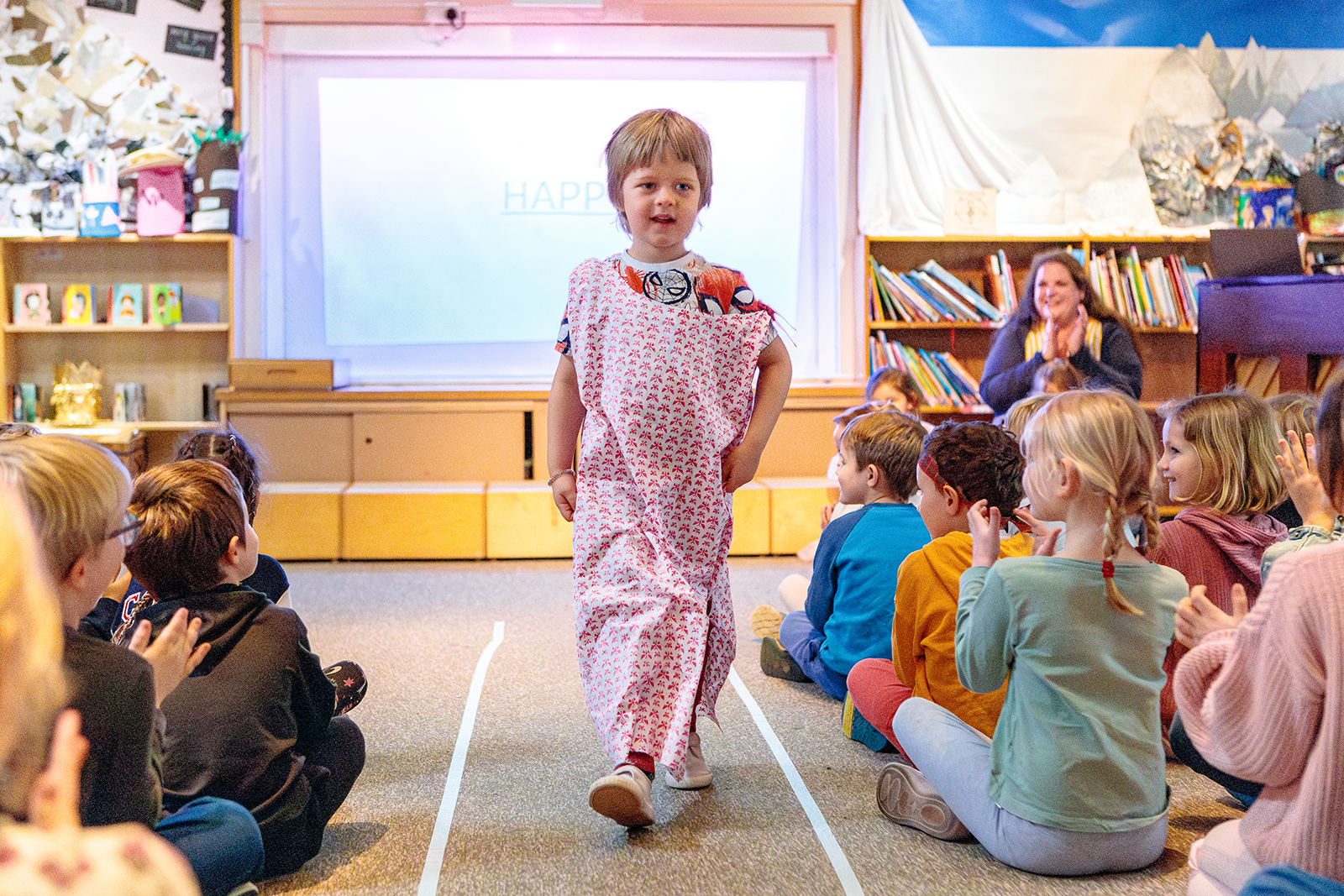
The Spring term concluded with a fabulous display of hard work from our Reception class, who transformed the library into a catwalk as they showcased the vibrant and creative party clothes they had impressively designed, cut and sewed themselves. 
 
The children had been inspired to make the outfits while exploring a learning enquiry about cultures, celebrations, and festivals, which saw them investigate party traditions, games, and cuisines. As the investigation broached the clothes people wear to parties, they asked if they could learn to use a sewing machine to make their own party clothes.

In preparation for making the clothes, the children looked through the school costume wardrobe and found a selection of fabrics and outfits they particularly liked, before designing an outfit they’d like to wear, with waistcoats, dresses and capes all popular choices. Finally, they used a sewing machine to stitch their garments together, carefully coordinating the foot pedal and guiding the fabric. 
 
At the fashion show, every child struck a pose down the runway in their handmade outfits as the rest of the school watched and cheered. It was a joy to witness just how proud the class were of their efforts, and to see everyone applauding them so supportively. After modelling their creations, the children celebrated with a well-deserved party back in their classroom, complete with delicious cupcakes they’d made for the occasion.

Reception’s fashion show is just one example of the impact of enquiry-based learning, which encourages children to extend their knowledge and understanding by exploring questions, problems, and scenarios. In contrast with traditional approaches such as rote learning, where students are recipients of information presented for memorisation, enquiry-led learning enables children to be active participants in the learning process, fostering coveted skills such as curiosity, creativity, and adaptability. 

We tailor the approach for every stage of the Pre-prep, so while all year groups start with the same broad enquiry, they explore it from different angles. With the cultures, celebrations and learning enquiry, for example, Nursery children delved into the topic of cultures around the world through magic carpet rides to a variety of countries across the globe. Students in Year 3, on the other hand, undertook a more in-depth investigation by deep-diving into Japanese culture, exploring the language, food and different art forms, before independently choosing one aspect to practise in preparation for a presentation to parents. 

Our approach ensures that children’s curiosity is nurtured in a way that is both age-appropriate and challenging, supporting them to develop a love of learning that will last a lifetime.

Sleep, learning and wellbeing

By Al McConville, Director of Teaching and Innovation

The crucial role of sleep in learning and wellbeing has been much in the press recently. As scientists gradually understand more fully the underlying processes of memory and cognition, it is increasingly clear how central a good night’s sleep is to optimal functioning.

At a recent Friends of Bedales meeting, a group of staff and students presented the latest research on sleep and adolescence, and how it relates to our practice, now, and potentially in the future. What, for example, would the impact of a later start to the school day be…?

I produced a handout sharing some key messages harvested from several books: Matthew Walker’s Why We Sleep; Till Roenneberg’s Internal Time; Sarah-Jane Blakemore’s Inventing Ourselves: The Secret Life of the Teenage Brain; and Dan Pink’s When: The Scientific Secrets of Perfect Timing.

  • Sleep is strongly correlated with success in laying down new memories and other elements of cognitive performance, including focus, understanding, speed of processing and problem-solving; age appropriate levels of sleep lead to better memory and optimal cognitive function overall.
  • During the day we store information in our short-term memory bank, the hippocampus. It needs to be cleared out daily to make space for new memories; that clearing out, or transfer to long-term memory in the cortex, happens primarily at night. Short-term memory capacity is refreshed in proportion to the number of ‘spindles’ that occur during sleep.
  • There is a strong biological setting in all individuals which dictates their natural waking/sleeping times – chronotypes. It’s not good for you to try and work against this; very little ‘entrainment’ (i.e. getting used to forced alternatives) is possible.
  • Sleep deprivation is correlated strongly with the full spectrum of mental health issues.
  • Even a relatively small but regular shortfall of the necessary sleep leads to sleep deprivation indicators.
  • The most important sleep for strengthening memory and learning (REM sleep) tends to happen at the tail end of the cycle, when the sleep is most ‘spindle-rich’, which is also the bit that is most often cut short.
  • Teenagers need nine hours’ sleep on average; 8-10 hours is the range. However, their chronotypes shift later by 1-3 hours during adolescence, so their natural bed/wake times shift later.
  • There is evidence from America in particular that shifting the same start time of schools back leads to improved academic performance. Locally, Alton College (sixth form only) starts at 10am.
  • Even with enough sleep, there are variations in the cycle as to when we’re most cognitively capable of doing different kinds of work: earlier in the cycle is better for analytical thinking, while later in the cycle is better for more creative, ‘diffuse’ work.
  • There is a big slump in attentiveness in the early afternoon for most people, adequately slept or not. This is somewhat later for teenagers. We’re ‘bi-phasic’ – people who know when their ‘slump’ is can (ideally) plan less cognitively demanding activities for that period.
  • Naps perform something of a corrective to sleep deprivation, though are only really a sticking plaster, since a full cycle is necessary to perform all the functions of sleep.
  • Watch out for alcohol – for memories to be fully, reliably ‘laid down’ takes several days, or rather several sleeps, and alcohol can wipe out new neuronal growth three days after a new memory is formed. Nicotine also reduces the depth of sleep.