By Clare Jarmy, Assistant Head (Learning & Development)
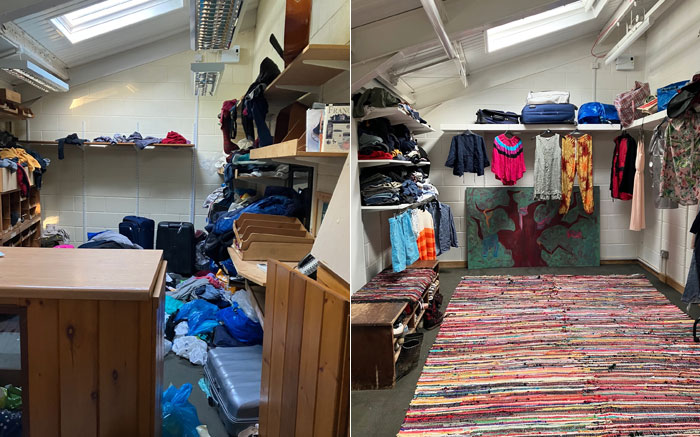
When, in September, we walked into what had been the Swap Shop (pictured on the left), I think all our hearts sank. It was a total mess. The shop had closed suddenly at the beginning of the first COVID lockdown, and it was our job to resurrect it.
Understandably, it had become a place where lots of lost property had been put, and amongst donations of clothes, other stuff had crept in: school books; stationery; lost DofE equipment; towels; broken electronics; suitcases. All the ephemerata of boarding life!
Everyone in Block 3 has worked on this project and on Parents’ Day, we were able to welcome our first visitors to the transformed shop (pictured above, on the right). The Free Shop will continue to run next year, and will be a good opportunity for those doing community service at Bedales. Student volunteers and donations always welcome!
Phoebe Cake: When we started the project, the Free Shop was known as the Swap Shop and it was originally intended for clothing swapping, trading, and possibly buying. We got into the shop and continued cleaning the insides and sorting clothing, and halfway through this process we decided that the shop should be called the Free Shop. We were inspired by hearing of another shop that was coming from a place of generosity and giving rather than swapping. But how do we keep up inventory? We are hoping for donations – but this is only possible with help from the community.
Henry Driver and Noah Huston: Our contribution to the Free Shop was primarily communicating with the Design team, and painting and putting up the shelves. We started off the term by deciding what shelves we were going to be using by collaborating with students from the other group. Then we helped paint the shelves, put up the shelves, and organise the hangers. Design Technician Emile Gailly was a key part of the project. From creating the shelves to helping put them up and re-upholstering furniture for the store, Emile was a needed cog in our very rusty machine. But through all of the ups and downs of the project we came out with a workable shop that would be able provide clothes for the people who needed it.
Olly Westwood and Guy Cumming: This term in the Free Shop, we have been assembling the shelves in preparation to open in time for Parents’ Day; thanks to Design Technician Emile for helping us put them up in his free time. We fully repainted the shelves, and arranged for the walls to be repainted, too, to give the shop a fresh look.
Aidan Casey: I helped the Free Shop by emailing a member of staff to ask how much funding we would have access to so we could plan what we would do with our first problem – the carpet. As the carpet was stained, we spoke to Facilities who suggested two solutions: clean the carpet to see if that would get rid of the stains, or buy a whole new carpet. We later decide that as it was over our budget to buy a new carpet, we would clean it, and were glad to find that after cleaning the stain was gone.
Tommy Hornsby: I worked with others to talk to Facilities about cleaning the carpet. They did such a great job once it was done, as at the start the carpet had many stains. After the preparations, in the last week we got the clothes into the shop and organised ready for the opening on Parents’ Day.
Paige Winstone: We created an ethical order form to establish whether any items we needed to purchase for the shop were ethical or not. In our form we questioned the ethics of the product so that if we did buy something, we would be able to make sure that the product fit with the Free Shop’s ethics. We had questions like ‘where was it made?’ and ‘who made it?’ We wanted to make sure that we got something that didn’t harm the environment, people, or animals. We couldn’t replace the carpet that was already there, so we decided to buy a rug and put it over top of it. Clare and I started looking for an ethically produced rug. We found one which, although it was from India, it was ethically made by women who were treated well with a good pay. It was also made from old scraps of fabric. It was reasonably priced, so we bought it with some of the £650 funding we received from the Bedales Parents’ Association (BPA). Now it looks great in the Free Shop and brings a lovely pop of colour to the room.
Jack Laing and Iris Oliver: Throughout the renovation of the Free Shop we painted and put up shelves, cleaned the carpet, bought a new ethical rug, organised clothes and accessories, collected, cleaned and fixed clothes rails, fixed and renovated a shoe bench, and much more. We worked together using our Projects lessons and extra time (a special shoutout to Arthur Searby for his hard work in Badley Times!) along with Clare Jarmy, Matt Meyer and Mungo Winkley, Emile Gailly and the Facilities team to put it all together.
Jamie Bolton: I helped re-upholster the leather shoe bench, where we had to ask Emile Gailly, Design Tutor Technician, for materials and tools to modernise the bench, but also keep its history there.
Platon Lesnevskiy: I helped put up all the shelves up and spoke to Facilities to arrange for the carpet to be cleaned. We carried clothing donations from Boys’ Flat to the Free Shop, sorted the clothes and shelved them ready for Parents’ Day.
Aidan Casey: The final job was moving the donated clothing back to the Free Shop from Boys’ Flat and sort them, ready to go onto the shelves. This did take a bit longer than expected as a lot of the stuff was mixed up and we had to find pairing shoes!
Harry Burnell-Nugent: Working on the Free Shop made me think about the bigger picture of the world and the immense importance of today’s issues. Fast fashion is real, it is bad for the environment, and it is affecting how the world is run. We need to stop this and shops like this are the way forward.
Leggy Vale: My experience with the free shop was mind opening; I learnt some things I would have never been interested in without this experience. We worked together as a team and had some great times. I have got to know many people and have seen what life is like without the true privilege many people at our school experience.

 Bedales School Blog
You must be logged in to post a comment.