Questioning GCSE

By Magnus Bashaarat, Head of Bedales

In a recent article by Haroon Siddique in The Guardian, Shadow Education Secretary Angela Rayner expressed concern that Tory education reforms are putting state school pupils at a disadvantage compared to those educated in independent schools. More specifically, the Labour party is demanding an inquiry on the basis that state school pupils are obliged to sit GCSEs whilst many independent schools favour IGCSEs. The former are harder, claims Labour, with MP Lucy Powell arguing that independent schools are gaming the system by offering their students easy options, and insulating them against the effects of reforms whilst they are bedding in.

Labour is quite right to want an inquiry, but not on this premise which is shaky to say the least and misses the mark by some distance. One key question concerns the relevance of GCSE level qualifications in an age when education to age 18 is compulsory. Another is about assessment orthodoxies and, in turn, the relationship between these and issues of wellbeing amongst young people that have caused such concern in recent times.

In 2016 former Education Secretary, Lord Baker decried the squeezing out of creative and technical subjects in our schools. I share Lord Baker’s views on the inadequacy of the GCSE curriculum in preparing young people for the 21st century labour market, and indeed would not be unhappy to see them go. If we must have them, however, an inquiry should then ask what the curriculum and assessment should look like. I would argue, and many in education and industry would agree, that GCSEs are narrow and dull, and do little to prepare students for what awaits them at A level, higher education and in the workplace.

When Education Secretary, Michael Gove introduced the ‘new’ GCSEs, he lit the fuse, then withdrew a safe distance, and ultimately reappeared at the Department for Environment, Food and Rural Affairs. His ‘new’ GCSEs were all about ‘rigour’, which essentially meant doing away with coursework, and placing all the assessment in a terminal exam at the end of Year 11, with little or no scope for ‘re-takes’. But the acquisition of knowledge replaced the learning and application of skills, and inconsistent, unaccountable and sloppy marking remained the norm.

This is why so many schools, including Bedales, favour IGCSE as the richer option, whilst at Bedales we went one step further in also creating Bedales Assessed Courses (BAC) for 13 non-core subjects including Classical Music, Design, History, Philosophy, Religion & Ethics and Outdoor Work. In the summer of 2018 our first cohort completed the new BAC in Global Awareness, which requires students to conduct their own research on a global issue – eg. food poverty, housing, public health – and, through collaboration, to apply what they have learned to the problem in a local context, and then present it. We are immensely proud of what we consider to be a pioneering, demanding and highly relevant educational programme. Our reward for this? For BACs to be ignored in education league tables, a fate shared increasingly with the unduly maligned IGCSEs.

There is a long tradition of radical liberal thought informing the design and content of mainstream education in this country; rather than looking to score easy political points by bashing independent schools. Labour would do young people and schools alike a much greater service by working with us in finding alternatives to a curriculum and assessment regime that is dull, out of touch and frankly oppressive. With former Cabinet Secretary Lord O’Donnell warning that an addiction to exams for young people ramps up the risk of a mental health epidemic, the reformed GCSE system – built around a conviction that only end of course exams can truly assess learning – seems a dangerous horse to back.

Alumni Relations

By Philip Parsons, Alumni Officer

As part of Bedales’ efforts to support and stay connected with the network of Old Bedalians, every year the Alumni Relations division of the school’s External Relations team organise several reunions.

For recent leavers, these gatherings come in the form of university reunions, which are organised by Alumni Liaison Manager Leana Seriau, University Liaison Officer Sarah Oakley and Alumni Officer Philip Parsons and hosted in cities or towns where Old Bedalians have gone on to study at university.

Last Thursday, 29 November, the series of university reunions continued in Bristol, where eight Old Bedalians studying at Bristol and Cardiff met – joined by Sarah and Philip – at the Hotel du Vin to renew acquaintance and share their post-Bedales experiences.

Students from the 2015, 2016 and 2017 year groups were all represented and subjects studied include History of Art, French, Law, Classics, Medicine, Theology, Economics and Pharmacy.

As their first official reunion as Old Bedalians, it was a very enjoyable evening and, as with previous events, we find it a useful way of keeping in touch and maintaining the extended Bedales family.

Find out more about the work of the Alumni office and read the profiles of Old Bedalians, visit the Alumni page on the Bedales website.

Speaking at HMC Conference

By Blossom Gottlieb, 6.2

I had the pleasure of assisting Alistair McConville last Friday at the Conference for Academic Deputy Heads and Directors of Studies in Brighton.

Al invited me to speak for around five minutes about my experience in education, with the view of how institution-led learning could improve our current curriculum. We ran two sessions, each addressing around 25 people for an hour and a half.

Supporting the concept of internally moderated assessments and our own Bedales Assessed Courses (BACs) in front of a somewhat sceptical audience was more challenging than I had expected. However, Al’s eloquent and inspirational arguments encouraged innovation in the vast majority of our attendees.

It was enlightening to meet so many influencers in the educational field and hear their opinions on what improvements could be made. I learnt some valuable oratory skills from listening to Al’s presentation and thoroughly enjoyed being a part of it.

I am incredibly grateful to have been given the opportunity – thank you Al.

By Alistair McConville, Director of Learning and Innovation

It’s daunting having ‘innovation’ in your job title… People expect you to be working on something earth-shattering!

No trips to Mars (yet), but Blossom Gottlieb and I did venture out to Brighton last week to address the Academic Deputy Heads of the Headmasters’ Conference on the subject of running your own innovative courses.

Blossom gave the Deputies a heart-felt blast about the damaging nature of metric-obsessed approaches to education, and the tedious treadmill of nine or ten GCSEs. I weighed in with our story of doing things more imaginatively through BACs and Enrichment.

We highlighted the ongoing gap between the skills that GCSEs test – memorisation; speed-writing; endurance – and the skills that young people really need for the world beyond: collaboration; communication; creativity, to name but a few, and showed how we had been able to incorporate these into our programme.

We hinted at what might come next: an even greater degree of inter-disciplinary, real-life, project-based work, which is what employers are crying out for, and by happy coincidence, what young people are engaged by!

Watch this space for Mars-based projects…

Sleep, learning and wellbeing

By Al McConville, Director of Teaching and Innovation

The crucial role of sleep in learning and wellbeing has been much in the press recently. As scientists gradually understand more fully the underlying processes of memory and cognition, it is increasingly clear how central a good night’s sleep is to optimal functioning.

At a recent Friends of Bedales meeting, a group of staff and students presented the latest research on sleep and adolescence, and how it relates to our practice, now, and potentially in the future. What, for example, would the impact of a later start to the school day be…?

I produced a handout sharing some key messages harvested from several books: Matthew Walker’s Why We Sleep; Till Roenneberg’s Internal Time; Sarah-Jane Blakemore’s Inventing Ourselves: The Secret Life of the Teenage Brain; and Dan Pink’s When: The Scientific Secrets of Perfect Timing.

  • Sleep is strongly correlated with success in laying down new memories and other elements of cognitive performance, including focus, understanding, speed of processing and problem-solving; age appropriate levels of sleep lead to better memory and optimal cognitive function overall.
  • During the day we store information in our short-term memory bank, the hippocampus. It needs to be cleared out daily to make space for new memories; that clearing out, or transfer to long-term memory in the cortex, happens primarily at night. Short-term memory capacity is refreshed in proportion to the number of ‘spindles’ that occur during sleep.
  • There is a strong biological setting in all individuals which dictates their natural waking/sleeping times – chronotypes. It’s not good for you to try and work against this; very little ‘entrainment’ (i.e. getting used to forced alternatives) is possible.
  • Sleep deprivation is correlated strongly with the full spectrum of mental health issues.
  • Even a relatively small but regular shortfall of the necessary sleep leads to sleep deprivation indicators.
  • The most important sleep for strengthening memory and learning (REM sleep) tends to happen at the tail end of the cycle, when the sleep is most ‘spindle-rich’, which is also the bit that is most often cut short.
  • Teenagers need nine hours’ sleep on average; 8-10 hours is the range. However, their chronotypes shift later by 1-3 hours during adolescence, so their natural bed/wake times shift later.
  • There is evidence from America in particular that shifting the same start time of schools back leads to improved academic performance. Locally, Alton College (sixth form only) starts at 10am.
  • Even with enough sleep, there are variations in the cycle as to when we’re most cognitively capable of doing different kinds of work: earlier in the cycle is better for analytical thinking, while later in the cycle is better for more creative, ‘diffuse’ work.
  • There is a big slump in attentiveness in the early afternoon for most people, adequately slept or not. This is somewhat later for teenagers. We’re ‘bi-phasic’ – people who know when their ‘slump’ is can (ideally) plan less cognitively demanding activities for that period.
  • Naps perform something of a corrective to sleep deprivation, though are only really a sticking plaster, since a full cycle is necessary to perform all the functions of sleep.
  • Watch out for alcohol – for memories to be fully, reliably ‘laid down’ takes several days, or rather several sleeps, and alcohol can wipe out new neuronal growth three days after a new memory is formed. Nicotine also reduces the depth of sleep.

Commission on Religious Education

By Clare Jarmy, Head of Philosophy, Religion & Ethics

The Commission on Religious Education (CoRE) recently reported its findings after a long period of consultation with stakeholders. CoRE was set up by the RE Council, but was run independently of it. As independent schools, we are unlikely to feel the full force of CoRE’s effect, but times are changing for Religious Education, and independent schools will surely find themselves influenced by the findings.

These key recommendations are likely to have the biggest effect on independent schools:

1. Religion & Worldviews

CoRE recommends that ‘Religious Education’ should be renamed ‘Religion & Worldviews’. Do not be fooled: this change of nomenclature is no mere windowdressing. The Commission recognises the huge change that has taken place in religious affiliation in the last fifty years, and argues that the subject must evolve to recognise this. Around 50% of adults in the UK have no religion. 41% identify as Christian. Focussing on ‘The Six World Religions’ does not reflect the religious (or increasingly nonreligious) nature of the UK. By introducing ‘worldviews’ to the subject, and requiring students to handle concepts such as secularism as well as religion, it is hoped that the subject will be useful in reflecting the conversations students will need to have in their lives as well as at work. Even though most schools in the Independent Sector tend to call this subject ‘Religious Studies’ and not ‘Religious Education’, this name change, and everything it implies, is causing controversy. The term ‘worldview’ is defined by the report, but not closely enough. Couldn’t a worldview mean any set of beliefs that are in some way foundational to the way someone sees the world? As Philip Robinson, the RE Advisor to the Catholic Education Service puts it, “communism, libertarianism, capitalism, nationalism and socialism are just a few nonreligious worldviews; should they be taught in RE too? It…seems hugely ironic that the answer to declining religious literacy should be to teach less religion.”

2. National Entitlement

Provision for RE has been found to be patchy in recent years, and increasing academisation of maintained sector schools has diminished the amount of RE being taught. 34.1% of academies with no religious character were not teaching any RE in KS3 in 2015; 43.7% at KS4. CoRE recommends that a National Entitlement is created to ensure that all students can access the subject. This might cause some independent schools to examine the provision they have in place themselves. Whilst there is no suggestion that independent schools will have to conform, the National Entitlement confirms the importance of the subject, and some independent schools might see fit to follow suit.

3. An ‘Academically Rich & Rigorous’ subject

A key aim that has come out of CoRE is a call for an “academically rich and rigorous” approach to the subject. Religious Education has historically served many goals: community cohesion; spiritual development; formation of world view; tolerance and understanding of others. Academic rigour has not always featured at the top of priorities in RE for successive governments. In the independent sector, there has been a longer history of an academic approach as the term ‘Religious Studies’ implies. The sector has a wealth of expertise amongst its teachers: expect to meet lots of textbook authors at the ISRSA Conference! Having argued that this is a challenging and academic subject, CoRE recommends that Religion and Worldviews is finally given the status that, as such, it deserves. For its whole history, RE has been a bit different, in its legal status, in its provision, in its locally agreed syllabuses, and, many would argue, this was for some good reasons. Yet, its unique place on the curriculum has also made it a bit of an outlier, difficult to categorise, and difficult, for some, to take seriously as an academic pursuit. Recent government decisions, namely the exclusion both of RE from the EBacc and of short-course RE from schools’ performance figures, have hugely undervalued the subject and led to a dramatic downturn in uptake nationally at GCSE. The Russell Group’s list of ‘facilitating’ subjects, where Religious Studies A Level is conspicuous by its absence, also hugely underestimates the usefulness of the subject for all sorts of areas of further study. CoRE requests that the Russell Group re-examines its list. Here, CoRE could have direct implications for the independent sector: some Heads of RS feel under an unfair amount of pressure to justify their subject, purely because of its seemingly arbitrary exclusion from that list. If CoRE’s recommendations are taken up, we can hope for better resourcing for teacher training, and hence higher quality applicants for jobs in both sectors. We can hope that students expect RS to be taught, and to be taught well, as it so often is by colleagues in the independent sector. More thanthis, we can hope, finally, to be understood for what we are. We are teachers of a valuable, viable, challenging and rigorous academic subject: so much more, but nothing less.

This article was originally published in Independent Schools Magazine

Remembrance Jaw

By Clare Jarmy, Head of Philosophy, Religious Studies & Ethics

At Dunhurst and Bedales, students commemorated the centenary of the Armistice at a Remembrance Jaw. Jaw at the Bedales Schools takes the place of chapel in more traditional independent schools. It is the time during the week for reflecting on philosophical, spiritual, religious and moral ideas and views.

Remembrance Jaw is the most solemn event in our calendar. The Bedales Archives project creating profiles of those Old Bedalians who died provided the substance for our commemoration. Students heard in much more detail than before about three Bedalians who died in 1918.

We heard about Edmund ‘Gabriel’ Rice, nephew Mrs Badley the founder’s wife. We remembered Ellis ‘Lynn’ Doncaster, who was shot down on the first day of the Battle of Amiens, and hence the start of what was to be known as the Hundred Days Offensive that ended the war. Finally, we remembered Oswald Horsley, known universally as ‘Pump’, a gentle giant, a lot of fun, and a popular choice for Head Boy.

Oswald was clearly an extremely courageous man, injured three times at the Front. In the offensive where he suffered considerable abdominal wounds, he continued to command his troops from where he lay injured. He was the only Officer to survive that day, and was awarded the MC. The day before he died in a test flight, having refused to retire after his injuries made a continued career in the infantry impossible, he came back to Bedales. As he left, he said he’d be back in a week. Tragically, he was right, as his body was brought back to the village for burial.

Our Founder, Mr Badley, wrote this poem dedicated to Oswald, which was read at his burial.

To O.H.

At parting, five short days ago
“This time it’s not for long” you said;
“You’ll see me back within the week.” And lo,
Your comrades bring you dead.

Their task done, each in token how
They prized their sunniest, bravest, best,
Advancing, gives the last salute; and now
They leave you here, to rest,

Where, by the old grey church, the view
Of half a county, weald and hill —
Wide almost as your vision from the blue —
Lies round you silent, still.

Rest, then, where you so loved to be,
Living, and, dead, be with us yet.
You have come back to us again, and so
Like you, we’ll not forget.

— JH Badley

The student-led curriculum group gets organised

By Alistair McConville, Director of Learning and Innovation

What springs to mind when you hear the word “Dons”? A candlelit high table crowded with kindly academics passing the port? Or a gathering of Mafioso types gathered in a back room, discussing the destination of the next horse’s head?

At our school, The Dons was the deliberately ambiguous name chosen for our latest venture in student leadership. The students struck on the name themselves, and were delighted by the way in which it hints both at academic ambition and rigour, yet retains overtones of anti-authoritarian subversion in the cause of “getting things done” a la Corleone…

As one of the pioneers of progressive education, Bedales has a long tradition of taking “student voice” very seriously indeed. Our school council, chaired by our head boy and girl, recently celebrated its 100th birthday. The Dons are the latest incarnation of this commitment to devolving meaningful responsibility to our students.

Essentially, the Dons are student leaders for each of the important elements of our school. Primarily, they are associated with academic departments – so the Don of biology or Spanish, for example – though other areas of school life also have a Don, such as our precious library.

The project was the students’ idea some four years ago. Above all, they wanted there to be students who could be approached for subject-specific help and advice by younger pupils, and who could become spokespeople for the subject, as well as representatives of the student body’s views to the relevant head of department (HoD). A consigliere of sorts, or perhaps something akin to a Roman tribune. Truth to power, but politely…

Respect the family

In the early days, the students were adamant that there should be no active oversight or management of this layer of student involvement from the adult leadership team. This was their baby, and they wanted it to operate in an entirely free-standing, organic way. Somewhat sceptically, we let them have their head.

This, frankly, led to a rather variable set of contributions across subject areas. A good number of Dons poured hours into supporting younger years, especially around GCSE time, and ran clubs and activities that related to the subject area. Others largely sat on their hands, revelling in the title and kudos, and boasting of it on their Ucas form, but were disappointingly unaccountable and inactive.

The students recognised the unfairness and ineffectiveness of this system, and soon sought to formalise the relationship between their network and the school’s more well-established structures.

The first big change for “Phase Two” was around the appointment process. We moved from a rather underground mechanism, whereby Dons more or less emerged from the shadows to be announced to HoDs by the students, to a rather more transparent process whereby aspirant Dons applied to the HoD, laying out their motivations and vision for the role. HoDs formally took on responsibility for managing their Don, and shared expectations were set. The head boy and girl attended a HoD meeting to negotiate the finer points.

The Don of teaching and learning is my sidekick in keeping some light reins on the whole project, which now feels distinctly more collaborative, embedded and effective than Dons 1.0, which now sleeps with the fishes.

What do they do? It’s delightfully disparate, with some students going across to our prep school to help lead activities or get involved in the science fair there.

Others organise external speakers and take responsibility for extracurricular societies. They pop up at the A-level choices fair to tell potential subscribers “what it’s really like”. No sugar-coating.

Flora, the religious-studies Don, is working on a student-sourced resource booklet for the new A level. Dons even attend departmental meetings from time to time to act as a sounding board on the issues of the day.

By far the most frequent offering is that of scheduled subject clinics for younger year groups, especially during our “quiet time” – Bedales’ light-touch version of old-school “prep” time. This proves especially popular in the run-up to exams and coursework deadlines – they’re literally being made an offer they can’t refuse.

Our most recent initiative was in response to a request from the governors that we make greater use of student feedback in shaping departmental development plans.

HoDs and Dons alike baulked at the idea of generating sheets of data from online questionnaires – both conscious of the dangers of headline metrics generated from tiny sample sizes – and negotiated a more qualitative way of identifying development areas.

So we planned a “feedback afternoon”, roughly following the model of a parents’ meeting, but with Dons behind the library desks instead of teachers, and students taking the place of parents. Students rolled through by year group to offer their unvarnished views on their experience, by subject, with Dons scribbling notes to translate (diplomatically and constructively, we trust) for their HoDs.

We’re mid-experiment, so how well this feedback will be converted into useful development priorities remains to be seen, but, nothing ventured…

An undoubted upside of all this is the inclusion of the students in the broader conversation about how teaching and learning happens. They have a voice.

There’s undoubtedly more work to do be done to refine the role of our motley, idealistic Dons, but it’s a stimulating dialogue with the students about how they can best be involved in the running of their community, and it can only be good for their general political and organisational awareness. Most hearteningly, it brings out their deep commitment to our very special school.

This article was originally published in TES magazine.

New cattle arrive at Bedales

Bedales-calf

By Andrew Martin, Head of Outdoor Work

Agnes and Audrey have joined us from Cowdray Farm Estate. Their mothers are Holstein Friesian cattle used for milking, their fathers are used for beef.

Agnes is a Holstein-Friesian cross Aberdeen-Angus. Aberdeen-Angus’s are a native breed, black in colour and known for their hardiness and the quality of their beef. They have a great temperament which we hope proves true as Agnes grows up!

Audrey is a Holstein-Friesian cross Hereford. Hereford cattle are very distinctive, with their white faces and markings, and auburn bodies.  Like the Aberdeen-Angus, Herefords fed on grass produce an excellent ‘marbled’ beef that is in great demand due to its distinctive flavour and quality.

Hereford cattle are another native breed famous for their good temperament. This should make Audrey and Agnes absolutely ideal for our school environment.

The calves are three weeks old, and fed on milk, barley straw and cereal. They will have the milk for roughly another six weeks, and then be weaned entirely onto cereals and barley straw for the winter. In the summer months they will only eat grass.

Very soon they will begin their halter training which is vital in order for us to move them around the site to fresh pastures (watch out for the cow pats!) Already we have three Block 4 students claiming the halter training as part of their Outdoor Work BAC project.

Once the cattle reach roughly 20 months they will be ready for either breeding or beef. What we decide to do with them depends on their behaviour, how our fields have coped with big animals and our appetite for either calves or beef!

Conference season

By Magnus Bashaarat, Head of Bedales

This year’s annual HMC Conference was held at the Midland Hotel in Manchester. The hotel was built on the site of the Peterloo Massacre in 1819, a bloody milestone along the treacherous road towards universal suffrage. It’s a stone’s throw away from what was the legendary club The Hacienda, now a block of luxury flats (sic transit gloria). But its most compelling claim to shaping history as opposed to having history happen on its doorstep was that Mr Rolls and Mr Royce had their first ever meeting in the hotel and decided that they would go into partnership: the engineer and the money man realising that each had something the other didn’t.

The theme of this year’s conference has been ‘Together to Learn’ – a title which is meant to work in all sorts of clever ways, of course, as we have all come together to learn from each other, from the long list of eminent speakers that have given presentations, and of course it’s a statement about how all teachers and all schools, whether independent or maintained sector, can learn from each other.

The 2018 HMC buzzword bingo was not particularly challenging. ‘Bursary provision’, ‘public benefit’ and ‘partnerships’ were the ‘go to’ mentions and proliferated the discourse whenever the lights were dimmed. Because of the political discourse in another conference going on in Birmingham, a conference even more important than a bunch of Heads of schools coming together to talk school stuff, much of the energy and talk in Manchester was about anticipating political change that might adversely affect the independent sector. The Labour Party conference that took place last week in Liverpool was a more important conference to watch from our school perspective because we can pretty safely assume that a Labour government taking office after the next general election would introduce legislation that would present real existential challenges to many schools in the independent sector.

So whilst we wait for the current Conservative administration to lead the country out of Europe into a post-Brexit world of complete uncertainty, we also have to plan for what Mr Corbyn might do when he gets the keys to No. 10. At Bedales we can speak loudly and proudly about what we do in terms of public benefit, bursary provision and partnership forming. The timing of Patrick Derham’s visit to Bedales last week when he spoke at Jaw about his own journey as a recipient of a bursary could not have been better timed as an example of what Bedales does through its John Badley Foundation to make a Bedales education available to aspiring students whose families just don’t have the means to meet the fees. We also have a range of exemplar partnerships with our local schools, and in particular a successful partnership with Bohunt School in Liphook. And last week the Outdoor Work department welcomed a group of young people from a pupil referral unit in Gosport who came to share our facilities. And there is so much more.

Patrick’s mantra about the ‘transformative power of education’ still resonates in my mind, and I have heard that phrase again this week in Manchester. Once we are through the conference season; Conservative, Labour and HMC, then teaching and learning comes centre stage again, and the classroom rather than the podium, rightly, is where the action is.

Transformative Education

By Clare Jarmy, Head of Philosophy, Religion & Ethics

An education is a transformative thing, and a great education can lead to a great transformation. Every student at Bedales is fortunate to have so many opportunities. Being part of a school like this, someone has invested in that transformation. For many, parents make this investment. Sometimes, it is grandparents. I have even known students paying their own fees out of inherited money. Others, and I was one of them, get to come to a school like this with the support of others, through bursary programmes. I can speak as one who knows: bursaries transform lives.

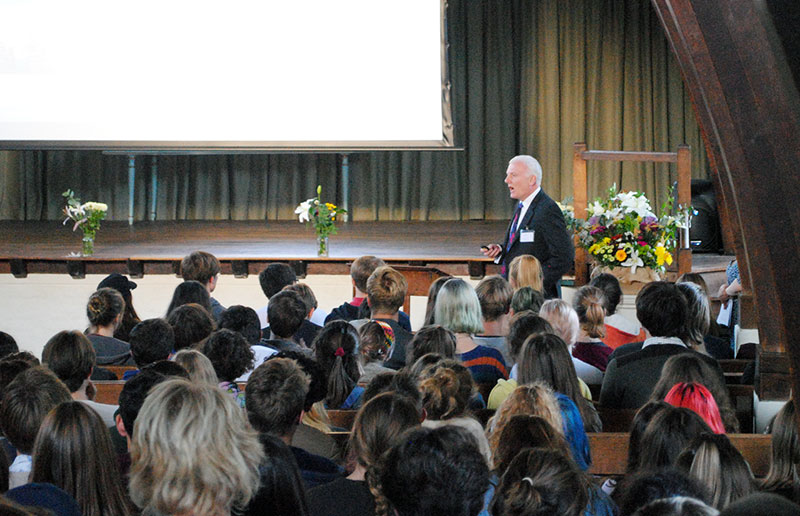
Patrick Derham, OBE, the Headmaster of Westminster, and formerly Rugby, knows this better than most. We were so fortunate to have him speak at Jaw on Wednesday, and the impact his talk had on students was palpable. Having, like me, been to seven schools before the age of 12, he was an ‘Ari Boy’, educated aboard the permanently moored vessel Arethusa. One day, he was asked ‘Do you know what Public School is, Derham?’ ‘No, Sir’, he replied. The school aboard the Arethusa was disbanded overnight, and he was sent off to Pangbourne College, a beneficiary of a bursary from an anonymous donor. It changed his life, giving him opportunities beyond his wildest dreams.

He took advantage of every chance, getting to Pembroke College, Cambridge, and has spent his career determined to give back. He started the celebrated Arnold (bursary) Foundation at Rugby, and from that went on to found Springboard, a national charity linking young people to places at boarding schools. He is involved with numerous other projects, all concerned with providing excellent educational opportunities to young people in difficult circumstances.

I can see why he said this was what ‘gets him out of bed in the morning’. Last year, I was thrilled and deeply moved to be asked to be a trustee of our own John Badley Foundation. Through the work of the JBF, students with backgrounds more like mine, and those much less fortunate than I was, can get to come here, and just as happens with every child, experience the transformation that comes from a great education.

For more information about the John Badley Foundation, click here.