This week saw the third and final Bedales Parents’ Association (BPA) gathering of the school year with a talk entitled ‘Bedales Outside the Classroom: Delivering the Head, Hand and Heart Experience’ (watch a recording of the talk here).
Lead by Deputy Head (Operational and Co-Curricular) Phil Tattersall-King, we were also joined by Spencer Leach (Director of Sport), Doug McIlwraith (Director of Music) and Jess Warren (Head of Psychology and Enrichment), along with two current Bedales students, Kam Nelson-Clayton (Block 5) and Jess Asamoa (6.1).
We looked at what’s on offer across the unique and far-reaching Bedales landscape outside of the classroom curriculum, and why these activities form such a vital part of the holistic Bedales experience for students and their families. We also delved into the need to strike the right balance between the compulsory and optional provision of music, sport, theatre and the myriad other opportunities available during a student’s time at Bedales.
The BPA are grateful to the team for giving us their time and energy and we’re so looking forward to holding more events like this one in the coming school year. Some online gatherings for those who can’t make it into school will remain, but we’re thrilled to start planning to gather together in person once again too!
One of the best takeaways from this week’s talk for me was the prospect of so many exciting events already lined up on the imminent school calendar that showcase the richness of our school’s co-curricular programme, with orchestral concerts, plays and dance recitals, the Rock Show and of course Parents’ Day all coming up before the end of this Summer Term. We look forward to seeing you around the campus and enjoying all that makes Bedales such a special place to be, together.
At the end of another busy half term for Drama, I wanted to take the opportunity to praise student achievements and share news of projects about to be shared.
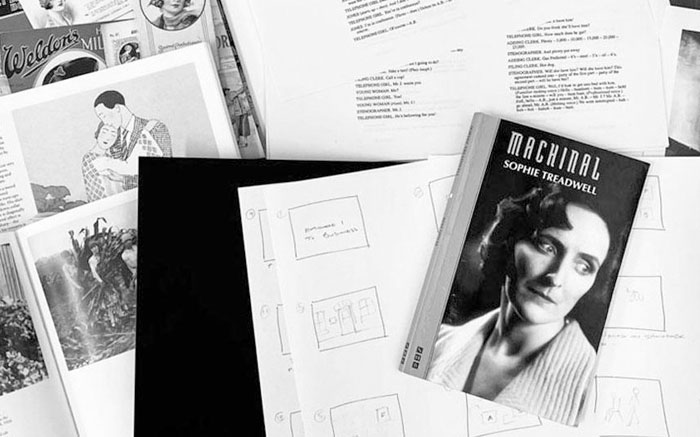
Machinal by Sophie Treadwell will be released daily episode by episode from Friday. The Spring Production started at home, and we wanted to share it with you at home. Rehearsals took place online and students were filmed individually. The footage was then edited into the nine-episode play. To access the links, visit the Bedales Events page. The whole show will be available for one week after all of the episodes have been released, in case you need to catch up or would prefer to binge watch!
The Summer Production, Chariots of Fire, is now well underway, and rehearsals are filling the Theatre and the Quad with energetic Block 3 and 4 students. We look forward to sharing this spectacular show with you on Parents’ Day or in the evening performances preceding it. Book tickets here.
Our Wednesday workshops have continued, and we have had the pleasure of working with Kate Winslet, Ben Muir and Martha Dancy on characterisation, dialect, the Meisner Technique and preparing for a career in the Arts. Martha, alongside the department, supported the 6.2s who applied for drama school this year. I am thrilled to share that August Janklow has received a place at East 15 on the Acting and Contemporary Theatre course and Nay Murphy has a place at the School Jacques LeCoq in Paris, alongside being shortlisted and awaiting final lists from Royal Central and Bristol Old Vic. We are incredibly proud of their achievements and Martha and I look forward to supporting the 6.1s with similar aspirations in their applications next year.
Nay was also longlisted in the National Theatre’s New Views playwriting competition, which you read about in an earlier Bulletin this term. It is a phenomenal achievement, considering the 600 plus applications. This competition is the culmination of the Playwriting enrichment course we run in Drama, and it is an excellent opportunity for those who want to refine their technique or try playwriting with teacher-led sessions and visits from a professional playwright.
Our other enrichment course is Student Directing and I am pleased that, having been temporarily halted during lockdown, the two plays are due to be realised in performance next half term. Nay is directing his play, The Definition of Charisma, and August is directing Sam Shepherd’s True West.
By Julia Bevan, Teacher of English and DofE Manager
Last weekend, the team from the approved activity provider Ridgeline Adventures returned to run a two-day Duke of Edinburgh (DofE) Bronze Expedition from Bedales to the Queen Elizabeth Country Park.
On Saturday morning, 33 Block 3 students walked out of Bedales in five groups for the first leg of the expedition to Duncombe Farm, East Meon. Each group, supported by an assessor from Ridgeline Adventures, had planned a different route to East Meon, which is around 2.5 hours from Bedales in a straight-line distance.
Although each of the groups were required to pass the Seven Stars pub on the A272 as part of their journey, the different routes they followed varied their experiences, as one group – who found themselves lost en route, and were forced to backtrack to get back on course – can testify! There were other challenges, too, such as loose soles on one student’s walking boots, which she successfully repaired after improvising with some duct tape. With the first group arriving at Duncombe Farm at 3.30pm, and the last group arriving at 6.30pm, the first day proved that you don’t always need to travel far for an adventure.
After camping overnight in East Meon, early morning birdsong at 3.30am provided an unwelcome wake-up call on day two. However, despite the birds’ morning chorus, the start of the day was deferred until 5.30am, when one student decided it was time to start dismantling his tent ready for the second part of his journey – much to the exasperation of his campmates!
Once everyone was up for the day, the students continued onward on their expedition to the Queen Elizabeth Country Park, ploughing their energy into scaling Butser Hill from the North side. On reaching the top, groups were met by assessors for a debrief, before they triumphantly walked down to meet the school minibuses and parents in the Visitor Centre car park. “How long will it take us to get back to school?” a student asked me as we reached our destination, to which I replied it would take around 10 minutes. “We’ve only travelled 10 minutes?!” was his bewildered response.
Thank you to everyone who made the weekend a success – the enthusiastic Block 3 students, the exceptional team from Ridgeline Adventures, and accompanying Bedales staff Gordon Dale, Clive Burch and Paul Beauchamp. This weekend it is the turn of Block 4 & 5 students as they complete their Silver Practice Expedition, also with Ridgeline Adventures.
An original composition by a Block 3 student Shoshana was recently shortlisted in the National Centre for Early Music (NCEM)’s Young Composers Award 2021. After performing her composition in the final on 13 May, Shoshana reflects here on her experience in the competition. Listen to Shoshana’s composition, ‘Dancing Through Time’, here.
By Shoshana Yugin-Power, Block 3
When I first heard about the NCEM Young Composers Award, I knew I had to enter for the chance to meet my favourite ensemble, Palisander. As a recorder player myself, I was keen to rise to the challenge to create a piece of dance music for four recorders.
The brief was broad and any dance music was allowed. I was inspired by the numerous YouTube videos I watched in lockdown of things changing rapidly through time – such as fashion, dance and music – and was particularly interested in the idea of the transition between the styles. My goal was to meet Palisander in person by being shortlisted for the final, but I never imagined that would really happen! I was thrilled to be contacted by NCEM to say I was in the final, after they had selected my piece from 68 other entries.
After numerous lockdowns and months when social distancing and bubbles had prevented orchestras and ensembles from gathering, it was with real excitement that I made my way to the city of York, home of the National Centre of Early Music, for the final earlier this month. Once I arrived in York (by train – I enjoyed every moment of the journey, including delays, as public transport in itself is something of a novelty at the moment), I made my way to St Margaret’s Church.
I was one of five finalists in the Under 18 category of the competition, which was sponsored by BBC Radio 3. I spent the day listening to the other finalists’ pieces and attending engaging workshops led by Dr Christopher Fox and Palisander. I was amazed with the standard of the other finalists and it was fascinating to see their interpretation of the brief. The moment I heard the winning entry in the Under 18 category, I knew it would be the winner – even before I heard the others. It was the dance of swallows in a murmuration.
In the workshop, I had to present my piece and work with Palisander to develop it even further. I learnt so much about how to negotiate changes to my piece to suit the players and how to present my work confidently. In the evening, there was a private concert involving all the young composers’ pieces as well as several pieces from Palisander’s repertoire.
The whole day was an incredible experience. Not only has enabled me to see myself as a composer, but I made many new friends and contacts, the winning composer gave me a copy of the winning entry to play with my recorder friends, and I am already writing my next piece with much more confidence than I previously had.
By Fiona Read, Head of Bedales Nursery & Pre-prep, Dunannie
The world is slowly reopening. As I write, those of us in England are anticipating being allowed to mix indoors once more, to enjoy again the human contact we used to take for granted, and to travel – albeit in a limited way for now.
It is exciting and welcome, and also a time to think carefully about how we want, and need, the world to be in the future. Central to this is our relationship to the natural world, with the COVID pandemic having underlined that we simply do as we please at our peril.
So, why should any of this be a concern for a pre-prep school head as she thinks about her school’s curriculum? One answer is that children are inheriting from us adults a world in which the pressures we place upon it mean it is more likely to bite us back. Consequently, exploring our relationship with nature and understanding the consequences of the choices we make are important. For example, COVID is widely understood to have originated at the uneasy interface of human and wild animal populations, and to have spread quickly through burgeoning urban populations, and our ever-growing appetite for migration – these are both the products of our age, and associated with a range of other ecological and human problems. If we are to avoid repeats of the pandemic, as well as other unwanted impacts, we need to rethink how we do things. Today’s children will be the next generation of problem solvers and will need to find creative solutions to the global challenges they will face in the future.
At least in part, that is why Dunannie has incorporated the Harmony Project into its framework for learning. Inspired by the vision of HRH The Prince of Wales and designed to help schools develop a curriculum inspired by nature, the project explores how applying principles of nature – such as interdependence and adaptation – can guide us in the ways we live both individually and collectively.
An understandable response might be that this is a little young for children to be grappling with such ideas. However, recent protests underline the importance of a healthy planet to young people, and at Dunannie we have been struck by the interest and understanding of our children. We don’t need to introduce them to the idea that there is a relationship between the choices we make and their wider impacts – they already know.
Equally important is that our adoption of the Harmony Project does not happen from a standing start. The Bedales ethos as established by founder John Badley – ‘Head, Hand and Heart’ – prescribes an education for the whole person, combining the academic, the practical and the social. Accordingly, we already take every opportunity to get children learning outside, which they love, with most, if not all, subjects benefitting from the connection. The time they traditionally spend identifying birds, growing vegetables and caring for lambs is as much a part of them growing into their adult selves as is time spent in the classroom and library.
Curriculum and formal learning aside, our application of the principles of nature through the Harmony Project can better ensure our pupils’ wellbeing and connection to their world – a particularly hot topic right now. In 2020, the re-opening of schools saw a renewed appeal for government to support the use of outdoor learning in response to the pandemic. In a letter to the Chair of the Education Select Committee, the group ‘Our Bright Future’, which included representatives from the Wildlife Trusts, the National Youth Agency, the Centre for Sustainable Energy and Friends of the Earth, identified recovery from the pandemic as an opportunity to reassess “how we socialise, work and learn”. Research shows that time spent learning outdoors and interacting with the natural world can raise children’s educational attainment, resilience, and wellbeing. The group proposed that this should be the subject of a government inquiry, with a view to making outdoor learning part of the regular curriculum. We are far from alone, then.
This may sound rather ‘high concept’ and a big change, but in practice it need be neither. Rather, the Harmony Project brings additional focus to many of the things that we already do and love, and will see us do more. Ours is a broad and flexible curriculum and, shaped by the interests and responses of our children, it will evolve and grow in true Bedales tradition –learning with a cloak of fun.
More information on the Harmony Project can be found here. There is more about Bedales Pre-prep, Dunannie here.
To mark Mental Health Awareness Week, the Health Centre would like to highlight some great resources for children and their parents, ranging from local charities to nationwide organisations.
We recognise that following this last year’s events, everyone is in a different place concerning their mental health and if you are looking for any information on specific conditions, support networks or wellbeing information please look at the websites and phone numbers below. We are always open to be contacted by parents or students for further support or signposting to relevant organisations at bedaleshealthcentre@bedales.org.uk.
Young Minds, the UK’s leading charity fighting for children and young people’s mental health, has information for parents here. Parents/caregivers can also contact Young Minds via their helpline (0808 802 5544) or by email (parents@youngminds.co.uk).
Hope Line UK is a confidential support and advice service for children and young people under the age of 35 who are experiencing thoughts of suicide, or anyone concerned that a young person could be thinking about suicide. Contact their helpline (0800 068 4141), send a text (07860039967) or email them (pat@papyrus-uk.org).
Sane is a leading mental health charity with a range of information and resources available on their website and a helpline (07984 967708) operated by professionals and trained volunteers.
Rethink is a charity helping to improve the lives of people severely affected by mental illness through our network of local groups, services and expert information.
Mind offers information and support for anyone living with or supporting someone with a mental health condition. Their website includes information for young people aged 11-18 here.
Headspace is an app designed to improve the health and happiness of the world through meditation mindfulness. The app is free to try, and you can subscribe for full access to meditations and mindfulness exercises covering everything from negative self-talk to how to improve motivation.
No Limits is a an award-winning, Hampshire-based, independent charity providing a unique combination of prevention, early intervention and crisis support to young people. Details about their virtual services, drop-ins and support groups can be found on their website.
Mermaids is a charity supporting gender-diverse kids, young people and their families. Their website includes information for young people and parents/caregivers.
Following the publication of testimonies on the Everyone’s Invited website, harrowing reports in the media and student action in the Spring Term, Bedales students and staff began working on a process called ‘Dialogue for Change’.
As a school that prides itself on equality and on a strong student voice, it is so important that we ensure the many different opinions within the conversation of sexual violence and harassment are heard in a safe and honest space.
‘Dialogue for Change’ is our community response to the campaign. However, to ensure we move forward as a community with a clear direction – where all our voices are represented – we recognise that a slow, deliberate process of dialogue is required. Working on reconciliation and peace building, facilitating discussions of challenging and emotional topics, and ensuring everyone has the opportunity to speak takes time, patience and bravery.
The process has been divided into four phases. We are currently in Phase 1, of sharing and listening to differing points of view with mutual acknowledgement. ‘Dialogue for Change’ has been discussed in assembly, students have received a questionnaire, with half of all students responding, and there have been opportunities for safe conversations in different groups and forums throughout this half of the term. Next week, students in Blocks 3 and 4 will have extended tutor times to explore two key topics – ‘just a joke’ and ‘the bystander effect’ – with similar sessions for Block 5 and 6.1 before half term.
This will lead us into Phase 2, where we will reflect on each other’s experience, and set up a working party to respond to the issues raised next academic year. In Phase 3, to be completed by the end of the Summer Term, we will consider what common goals and values we share and what immediate changes can be made. Finally, in Phase 4, we will work on building the confidence of each party so all feel they are being heard. This will be an exploratory phase of trying new things and building projects, ideas and solutions, and establishing how we take this forward into the next academic year.
We believe this is a unique opportunity for us to help facilitate genuine, open and honest dialogue amongst students, for them to find their voices and engage with such an important topic, and to help drive it forward into real positive change.
On Wednesday afternoon, we were both pleased and excited to host Gordon’s School for a first and second team girls’ hockey fixture. This was the first time the two schools had met, but knowing the calibre of Gordon’s, we knew we would be in for an incredibly tough two games.
In the first team match, Gordon’s came out blazing, going 1-0 up with an excellent reverse stick finish inside the first five minutes and within 15 minutes a slightly shell-shocked Bedales side found themselves 4-0 down. However, slowly but surely, the Bedales side picked up the pace of the game and started to earn more possession, increasing their pattern of passes and attacking threat, much of which was implemented by the impressive Alisia Leach.
Credit to the Gordon’s side who continued to move the ball round well in the second half and were a constant threat going forward. The scoreline could have been vastly different if it weren’t for the numerous tackles and interceptions made by centre half Rebekah Leach and the two full backs, Esther Stewart and Shanklin Mackillop-Hall. Towards the end of the second half, the Bedales side earned themselves a consolation goal – the hard-working Sasha Arney, chasing down a ‘lost cause’ to bravely bundle the ball over the line following a freak deflection off the post. Fantastic game against a quality opposition.
The second XI game was a much closer affair, with the Bedales team the more threatening in the first half, mainly down to the incredible stick skills of Anna Tasker at left forward and the incredibly impressive Sage Bidwell at right forward. At half-time, Bedales were 2-0 to the good, with a debut goal for Issy Robinson and a calm finish from Kamaya Nelson-Clayton, following a fantastic drive to the baseline from Sage.
The second half was a different story as the Gordon’s side shut down many of our attacking outlets and gained more and more sustained possession in and around our defensive circle. Goalkeeper Rosie Voyantzis and the full back pairing of Lally Arengo-Jones and Maya Cressman were all incredibly impressive but couldn’t stop a strong comeback from Gordon’s, who ended up winning 3-2.
Starting a new school presents challenges and starting a new school mid-year more so, but starting a new school in a global pandemic feels like throwing yourself in at the deep end. And yet, here I am, just over three weeks in to my first term at Bedales and the water’s lovely.
I have been ‘courting’ Bedales for three years and am excited to have arrived. For me, the most immediately powerful thing I’ve appreciated has been the people who have made me feel so welcome: students, staff, parents and the local community in Steep and beyond.
Something I was inspired by three years ago when I first visited and I’m delighted to see very much alive today is the spirit of the students here. For example, in my first (online) assembly, I introduced myself and asked the students to say hello to me as I walked around the campus; I was candid enough to confess to feeling a little nervous, being a new arrival. Some might have thought it unwise to admit such blatant vulnerability to an adolescent audience; however Bedales is no ordinary school and, for the next week, I was treated to delightful greetings from students of all ages. Outwith their warmth and kindness, I’ve had many interesting discussions with students on topics as diverse as prohibition, gender and whether or not we need school rules. I am filled with excitement about working with such lively and engaged young people.
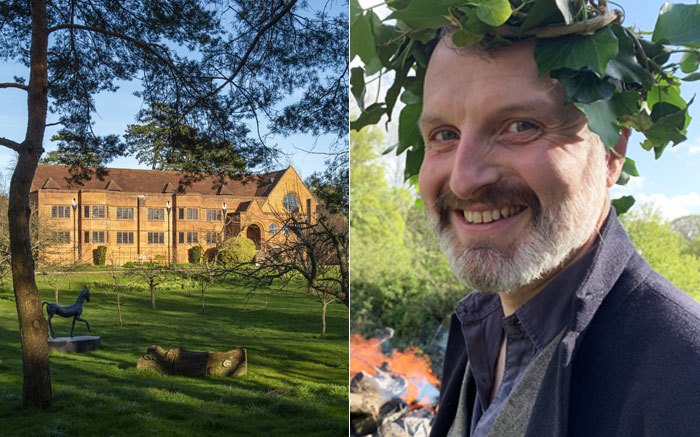
I’ve been equally delighted to meet colleagues with whom I have so much in common, both in terms of our professional values, but also our broader concerns and beliefs. It’s been fun, for example, getting to know Andrew and his team in Outdoor Work who’ve taught me about their late-night vigils watching over the pregnant sheep, introduced me to Favour and Tasty (two of the delightful school cows) and finding myself amused at the sunburnt piglets grunting away in the spring sunshine. I also loved celebrating Beltane around a camp fire, while wearing a crown of ivy.
My new colleagues have patiently talked me through their work and begun teaching me the poetic, if baffling, vocabulary of the place. I can confidently say that I know the quickest way to ‘Peef’ and have enjoyed my first ‘Jaw’. David over in the English department has already shared with me some insights to Edward Thomas’ time living and working at the school which have brought his poems to life anew. I’ve even been able to sing in the church choir (socially distanced and COVID-safe, of course).
In the classroom, I’m particularly excited about the work we’re doing on project-based learning with our Block 3 students – something we’ll be finessing next year now that we’ve run nearly a full cycle of our new venture into cross-curricular learning. I’m also loving the variety and depth of our BACs which are now in the final stages of moderation.
While there is so much to enjoy about living in Hampshire at a school like Bedales, there are, of course, challenges: coming out of lockdown and slowly reducing the measures in place to combat COVID-19 is particularly frustrating for a school which values so highly the interpersonal (handshaking is still not allowed); our Block 5 and 6.2 students are working their way valiantly through the final weeks of assessments to provide evidence for their GCSE and A Level grades; and we do not underestimate the time it will take to bring our whole community fully back together again. Luckily, with the people, the environment and the traditions that make up this school, we are ready to make the most of what we have here.
For me, it is such a privilege to already feel part of this community and I’m so excited about the months and years to come.
Three weeks into the new term and three phenomenal Wednesday Workshops have already been delivered. We have been so lucky with the wealth of experience that has been shared in these workshops and the generosity of professionals in the industry to share their time and their insight with our students has been invaluable.
Kate Winslet returned to deliver another workshop on characterisation, sharing her scripts and her own character notes alongside photographs from set. The students were enthralled by the schedules and script edits they saw and could truly appreciate the graft of acting and the research and exploration an actor should and must do to truly inhabit a role. Kate then delivered a separate more intimate session on American dialect for a student directed group and the difference in accents used by the actors at the end was astonishing. I know they will continue to practise using the crib sheets and techniques taught – and I will too!
Ben Press delivered his second session in person, and it was lovely to welcome him to Bedales and for him to share his experience and expertise in the Meisner method. Students were intrigued by this different way of working and the simplicity of responding and reacting to create truth on stage. I look forward to learning every Wednesday with the students and gaining these industry insights in the most memorable way.
Read a selection of students’ perspectives on the workshops below.
Poppy Brough, 6.2
Kate Winslet, a world-renowned actor, came to Bedales and delivered a second acting workshop for all students interested in Drama. She answered many questions from the students about her career delivering full and interesting answers, while also giving us funny anecdotes about being on set. She also showed us some photographs taken on different film sets. I particularly liked the picture of a massive sink in Eternal Sunshine of a Spotless Mind.
Kate was very open and didn’t judge anyone’s questions, creating a warm open atmosphere that was comfortable for everyone.
She talked enthusiastically about her new series Mare of Easttown, set in Pennsylvania, where she plays a grieving detective. She spoke about the intensity of the role and gave us valuable acting tips for filming out of chronological order, which is necessary to avoid time wastage.
We would really like to thank her for the precious time she gave to us, and we hope that she comes again soon.
Kit Mayhook-Walker, 6.1
To assist 6.2 student August Janklow with his student led adaptation of Sam Shepherd’s True West, Kate Winslet kindly agreed to come in to give the cast a workshop on dialect. The two-hour workshop focused on everything from pronunciation, articulation and how accent informs character. She gave each member of the cast a dialect pronunciation sheet which actors use to better understand the sounds common in specific regional accents, southern Californian being the one in question. she also sat in on a scene reading and offered her advice and opinions on vocal characterisation and specific things for each actor to focus on and remember while acting. The workshop was extremely helpful and useful in the development of the play and we are extremely grateful she took the time to come in and assist all involved.
Zeb Murphy, Block 3
I attended a workshop given by Ben Press, an actor who studied in New York. He spoke to us about the Meisner technique. It is an acting method developed by Sanford Meisner, under the influence of Stanislavski, Lee Strasburg and Stella Adler.
The first activity Ben introduced to us was the ‘Repetition Game’, as he called it. Two people had to sit face-to-face, side-to-side, or back-to-back. Then we had to simply follow three instructions; Don’t say anything until something causes you to speak, Don’t try to be interesting, The other person is the most important being in the entire world.
The general idea of the game was quite simple. Whatever the other one says about you, you just repeat but change it to ‘I’ instead of ‘You’. For example, this is a possible round:
Person 1: “You are looking at my feet”
Person 2: “I am looking at your feet”
And so on…
What is noticeable, is that even though we are trying not to act, the tone in which the phrase is said will continually change, and the partner must always react to how you said the phrase. It was incredible and hilarious to watch. It was mind blowing that this simple activity, of not even trying to act, was more enjoyable to watch than half the acting scenes I have seen in theatre.
Ben then made the exercise even more challenging by requesting that one member of the pair, had to be attempting a near impossible task, such as stacking three golf balls on top of one another. The person assigned the task began their challenge, whilst the other person had to walk into the room and do as follows:
· Walk into the room as if it was the most important thing to do
· Say nothing
· Observe what is occurring in the room
· Still say absolutely nothing
· Only speak when something in the room causes you to speak.
The Repetition Game would continue with the same earlier rules. This time, when the moment felt right, you were allowed to break the repeated phrase and change it to something else you needed to express. It was incredible to both watch and perform this challenging activity.
Overall, the workshop taught me that not trying to be interesting when acting can bizarrely be the most interesting thing to do. Good acting is about the way you say something rather than what you say, noticing and reacting is just as important as acting out your rehearsed part. I absolutely adored this workshop and I hope Ben will return to Bedales for another lesson”.




 Bedales School Blog
You must be logged in to post a comment.