Pastoral update: Safer Internet Day

By Ana Simmons, Head of Lower School and Acting Designated Safeguarding Lead

Over the last few years the UK’s internet use has surged as coronavirus saw a change in the way in which we all communicated; nationally Snapchat, Tiktok, Instagram, YouTube became key in how many people kept in touch and remained informed.

Using the internet safely and positively is a key message that we promote and actively work with the students on across all three schools at Bedales. This week many schools and youth organisations across the UK celebrated Safer Internet Day and for us the day gave us a chance to reflect upon how we emphasise the online safety messages and education we deliver throughout the year.

We all play a crucial role in empowering and supporting young people to use digital technologies responsibly, respectfully, critically and creatively. At school, we have released a newly issued Digital Safety Policy, now viewable on the Parent Portal, which captures how we ensure that all pupils are educated about and protected from potential harm online.

As ever, creating an open dialogue with students on how we use the internet is vital in supporting their online lives. Some resources which you may find helpful as parents in having these discussions with your child about their online usage are:

  • Advice for parents and carers from Childnet
  • Tips, advice and guides for parents and carers from the UK Safer Internet Centre
  • Guides on popular apps and games from NetAware
  • Reviews and information about games, apps, TV shows and websites from Common Sense Media
  • Help on using parental controls and privacy settings from Internet Matters
  • Information and reporting of online grooming or abuse from CEOP

And as ever, please do get in touch with Houseparents or myself, as the Designated Safeguarding Lead whilst Jen is on maternity leave, should you have any concerns or questions over how the internet is being used within the Bedales community.

Novelist inspires creative writing enrichment

By Jemima Corcoran, 6.1

Aspiring writers and journalists in Sixth Form and Block 5 were given the opportunity to hear from Teddy James, author and father of Old Bedalian Emilia Barnsdale-Ward, last Friday as part of our Creative Writing course for the Sixth Form Enrichment programme.

With a clear enthusiasm for history, Teddy spoke to us about his new book Relique of the Sunken Day. His first published novel, it centres around the nuclear testing carried out by the Soviet Union during the Cold War, and the long-term effects this had on those directly involved. Although the historical accuracy of his fiction is fascinating in itself, Teddy has also managed to intertwine a motif of descriptive imagery that takes inspiration from the great English poets – particularly Coleridge – as well as exploring the ethical and moral dilemmas surrounding communism, authority and patriotism.

Overall, our session with Teddy proved incredibly useful and inspiring, as we learnt all about the world of writing, how to find a publisher, and what can provide us with inspiration – which, for Teddy, ranges from the work of other authors (such as Evelyn Waugh) to real-life scenarios and historical events. Most apparent, however, was his strong passion for reading, and his advice to us about the importance of literature, and how our imagination and creativity can develop by passing our time engrossed in books.

A huge thank you to Teddy James for taking the time to answer our questions, offer professional advice and inspire us all, and to Head of English David Anson for arranging this amazing opportunity that will benefit many of us in our future writing endeavours.

Forging ahead with Outdoor Work projects

By Jo Cole, Outdoor Work technician

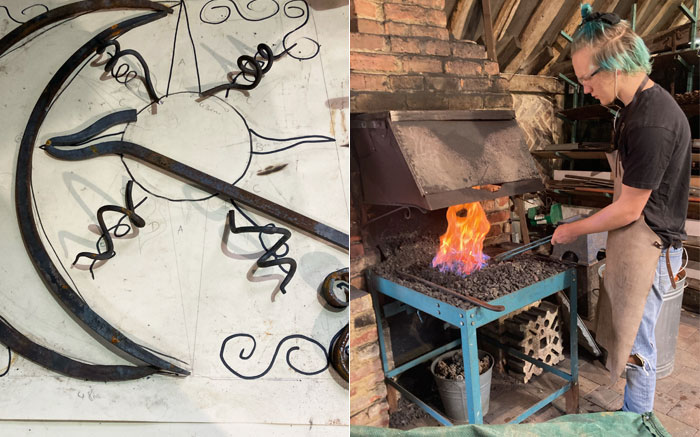
On a chilly Saturday in January I stepped out of my normal role of laying fires, checking tools, stocks and equipment in the forge and joined some of our Block 5 and Sixth Form students for a day with our visiting blacksmith, Lucille Scott from Little Duck Forge

The students aim was to work on their projects; mine was to learn a few basic techniques and make some latches for the barn doors.

There are no thermometers, gauges or apps indicating the temperature of the forges. Instead you have to learn to watch the colour of the coals and read the heat to judge the ‘just right’ moment to remove the work. Remove it too soon and you tire yourself out trying to hammer steel that is cold and won’t give. But leave it too long and you risk burning away the steel – and your efforts so far – entirely.   

I didn’t take me long to realise that it is pretty hard work! Once hot, the steel is only malleable for a very short time. I needed to plan ahead to ensure I had the right tools immediately to hand and to rapidly speed up my decision making.

As I worked away trying to encourage the steel to yield to my will, I was inspired by the students around me. In the few months they have been learning they have absorbed a deeper understanding of blacksmithing than perhaps they realise, both through Lucille’s teaching and their own experiences. 

They moved with ease round the forge, choosing the correct tools for the work in hand. They worked swiftly and adeptly, asking advice only where needed. The complexity of the shapes they were tackling was impressive.

Projects underway included an outdoor cooking tripod, a cutlery set and jewellery. They also include legacy panels inspired by the Bedales estate, which will be galvanised and possibility even gilded in places, before being set into the new timber-framed archway by the study in Outdoor Work. 

Spurred on by the students’ work, I ploughed on. Sometimes with ease, but frequently not! By the end of the day I was definitely quicker and the correct technique was starting to click.

Many thanks to Lucille, Beau, Lila, Lucy and Rosie for sharing their day with me.   

Walking from Syria to Steep to support refugees

By Abi Wharton, Head of Global Perspectives, Geography and Politics

On Tuesday 8 March, the Bedales community will be off timetable for our termly community day – this term being Powell Day. It feels particularly important that we spend this day as a community after the tribulations of recent years – coming together to raise awareness and vital funds for those that continue to need support.

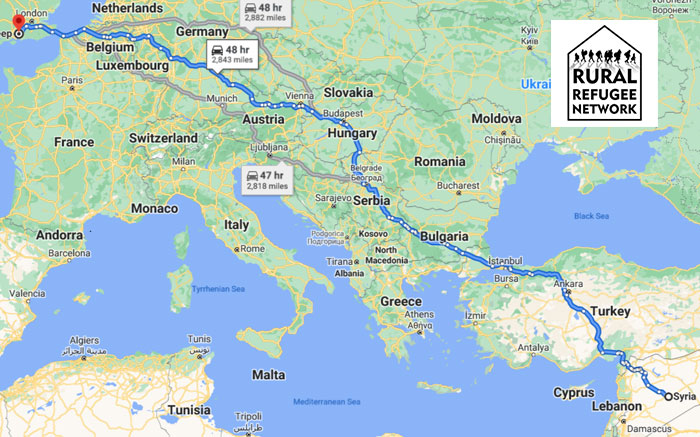
We are very excited to give you more information about our collective initiative to walk, as a school, the distance from Northern Syria to Steep in a single day (roughly 4500km). In tutor and year groups, Bedales students and staff will be walking a 10km route around Queen Elizabeth Country Park to raise sponsorship for the Rural Refugee Network, our charity partner. We are encouraging all tutor groups to raise at least £250 in sponsorship but encouraging some healthy competition by awarding prizes to both the tutor group and year group that raise the most in sponsorship!

Students will be able to give family and friends a URL allowing you to donate directly to their team via Give Penny, our chosen fundraising platform. We really hope you will be able to contribute to this worthwhile cause where both you and the students will be able to see exactly where these vital funds go. We would also be delighted if parents would like to participate on the walk itself.

I am also delighted that Gulwali Passarlay, a dear friend of the school who delivered the Global Awareness Lecture in 2017 will be joining us for the day to speak to the students and join us on the walk. Gulwali’s story is inspiring. It includes a 12-month odyssey across Europe to escape war-torn Afghanistan, arrival in the UK and graduation from one of the UK’s top universities. Gulwali Passarlay is a speaker, activist and former refugee who arrived in Britain in 2007, aged just 12, after being separated from his brother during his travels. His best-selling book, The Lightless Sky, is an account of his lone travels as a child including a 50-hour sea crossing in cramped quarters with more than 100 other refugees. At the time of the lecture, I said: “Gulwali’s resilience, determination and humour is a lesson to us all. He has faced unimaginable hardship and had his childhood taken away. Despite this, he bears no grudges, and has instead dedicated his life to raising awareness and improving the lives of millions of people around the world.” I think this message remains important as we look forward to 8 March – and I have certainly quoted the above when students have been a little reluctant about walking 10km!

Boys’ First XI Hockey v Ryde School

By Kevin Boniface, Head of Hockey

On Wednesday, the first XI hosted Ryde School. Both sides should be credited for their contribution to a fantastic game – arguably one of the best boys’ first XI games seen on the Astro for a while.

Ryde started strongly, pinning back the Bedales side and deservedly taking a 1-0 lead. It was however, incredibly pleasing to see the Bedales side respond well to this, fighting their way back in to the game through the influential Zach Stewart and deservedly grabbing an equaliser through a well worked short corner – the week of self-directed practice paying off! With the imperious Sol Arbib and his sidekick Bruno Heggie keeping things tight at the back, this allowed the creative influences of Elio Mazas, Sam Gibbon, Jac Wheeler and Felix Bicknell to gain more possession in the right areas and Bedales deservedly took the lead just before half-time with a neat finish from Ben Greening who found himself in the perfect back-post position.

The second half ebbed and flowed, but it was the away side who created more clear cut chances. However, some missed opportunities and superb goalkeeping from captain Josh Baty ensured that Ryde didn’t add to their first goal and after an injury break, Felix Bicknell took advantage of a Ryde re-shuffle, finishing accurately in the far corner to give the Bedales side a perhaps slightly flattering 3-1 margin in a deserved victory.

The best performance so far of the season for the Bedales team against a very competitive opposition.

Prep schools visit Bedales for Music Day

By Doug McIlwraith, Director of Music

On Thursday, we welcomed 40 pupils from Dorset House School, The Prebendal School and Froxfield and Steep primary schools for a music day. They were joined and supported brilliantly by over 20 Bedalians who assisted with pieces for orchestra and choir. The orchestra learnt music by Purcell and Dvorak, as well as a piece specially written for the occasion, which blended a bit of techno with orchestral colour, and the pupils thoroughly enjoyed. 

It was wonderful to see how our students interacted with the young visitors and helped build their enthusiasm and confidence and the whole group made swift and pleasing progress. We then opened the doors to let in some fresh air and sang several silly songs and a choral rendition of Ben E King’s Stand By Me. Our guitar teacher Kevin Walker was on hand to assist a group of fledgling guitarists ably assisted by Block 3 student Wulfie Pink-Smith and they worked on a blues improvisation. Imogen Tillotsen and Elliot Cundy gave impressive performances on harp and piano to inspire the visitors – and then they had an amazing 45-minute preview of the Rock Show which utterly blew their minds! The day ended with an open workshop for visiting parents where we presented the fruits of our work.

Thanks so much to all of our students who helped in the Lupton Hall and to the Rock Show musicians who contributed magnificently to the event. It was our first musical event where we have been able to invite young musicians from beyond our community to join us and we look forward to future joint events where Bedalian musicians can help inspire a new generation of young players. Particular thanks go to Janie Jarman, Rachel Hinett and Matt Potts for ensuring everyone was in the right place at the right time and well fed.

Bedales Boys’ First XI Hockey v Embley Park

By Kevin Boniface, Head of Hockey

On Wednesday the boys’ first XI hockey travelled to play Embley Park. The game got off to an absolute flyer with Bedales going 1-0 up with a fast counter-attacking move, replicating their work in training on Monday, finished off neatly by Felix Bicknell. However, almost within seconds Embley had equalised and the score was 1-1 within three minutes. Pleasingly, this set the tone for the remainder of the game, with both sides creating a number of chances. The Embley side contained a number of talented, representative players but this was well matched by the harder-working and slightly more structured Bedales team. The first half saw another three goals, all of a very high calibre; a drag-flick short corner and rasping finish from a tight angle for Embley, alongside a very well worked team goal for Bedales that was finished off by Nate Shuster after excellent work in the middle of the pitch from Jac Wheeler, Zach Stewart and the incredibly productive and fleet-footed Sam Gibbon.
 
As we moved in to the second half, it was hard to call which way the game would go. Zach maintained his influence in the middle of the pitch and Bedales were productive down the right channel with Elio Mazas and Sam Gibbon. But Embley remained a constant threat going forward and used the aerial ball to maintain territory. However, it is credit to goalkeeper Josh Baty and the defensive unit of Sol Arbib and Bruno Heggie that clear attacking threats were limited to three short corners. At the other end, Bedales created a number of good open play chances but failed to convert and ultimately paid the price when pressing for the equaliser were left exposed at the back and Embley neatly converted to win 4-2. Fantastic game. Credit to both sides for playing their part in a very competitive game.

Creative responses to philosophical ideas

By Josh Block, Head of Philosophy and Religious Studies

One of the key aspects of philosophy is the emphasis on having an open mind and being willing to engage with and sometimes embrace a wide range of new and perplexing ideas. As Aristotle put it: “It is the mark of an educated mind to be able to entertain a thought without accepting it.”

On this basis, the Block 5 Philosophy, Religi and Ethics (PRE) students are a highly educated lot indeed! This year so far they have encountered thinkers from Plato to Turing, the existence of no world to many worlds, and their reality not being real at all. To say nothing of the ever-topical question of whether AI is about to take over the human race! They have embraced all of this with enthusiasm and the well known Bedalian desire for more, and not necessarily simple, answers.

As part of their BAC assessment the students produced creative responses to a chosen aspect of the areas they had studied. They could choose their topic, media, focus and conclusions with complete freedom – or at least perceived freedom as there was inevitably a mark scheme which had to be followed! But all of this was met with passion and skill; the range of ideas was inspiring, and the means of execution nothing short of mind-blowing.

As nothing I type will actually do the work justice, I will allow as the phrase goes ‘an image to speak a thousand words’. Cast your eye over the images, and if you happen to be the parent or guardian of one of the students involved, please congratulate them and if they haven’t already, ask them to help you entertain new thoughts!

We need to talk

By Colin Baty, Head of Bedales Prep, Dunhurst

As a headteacher with significant pastoral responsibilities, I read the findings from the recently published report from Edurio – Pupil Learning Experience and Wellbeing Review: Pupil Experience in Schools and Multi-Academy Trusts – with discomfort.

The result of a sizeable survey of pupils from primary, secondary and all-through schools, the report covers topics from the learning environment and learning excellence to wellbeing and safeguarding, with a view to enabling school leaders to understand pupils’ needs and priorities and design strategies to mitigate the impact of COVID-19.

The finding with perhaps the greatest sting is that, although less than one half of pupils report feeling well (stress, overwork and sleep are issues for many), under one third will speak to a teacher about it when feeling sad or worried. This is deeply concerning, although perhaps not that surprising. The issue of wellbeing amongst young people has deep roots, and a previous study by Demos suggests that pupils become increasingly disaffected with their school as they get older, with a third of final year students believing their school is focused only on preparing them to succeed in exams, rather than in life. We should also factor into this the government’s enthusiasm for the idea that a ‘good education’ is one transmitted largely from the front of the class by authoritative teachers to quiet, attentive childrenThe recent appointment of Katherine Birbalsingh (Britain’s so-called strictest headteacher) as the government’s social mobility commissioner appears to confirm the idea of teacher as disciplinarian above all else.

Were I at school under such conditions, I’m not sure that I would want to share my worries with a teacher either, and that thought saddens me – not least because I know how keen my colleagues are to be a force for good in the lives of their pupils. I am fortunate to lead a school that makes central to everything it does not only the wellbeing of its pupils, but also the primacy of connection between pupils and adults as key to this being achieved. 

Arguably, this has never been as important as it is right now as we continue to emerge from the pandemic. At Bedales Prep, Dunhurst, we have taken the view that above all else we must pay attention to our pupils, and get a sense of how they are – how they see the world, and themselves. They may well have spent a lot of time looking at screens indoors (itself associated with issues of wellbeing in normal times), and will need to get used to being with their peers once more. So, we have spent as much time outdoors with them as we possibly can – talking, and slowly getting used to being with each other again. Of course, there has been learning too – a carefully-planned cross-curricular programme that has hidden its light in a bushel of fun. However, our first and most important job has been to figure out where they are and help them get them back to land. Whatever the future may hold, we will bring everybody together when we can – and keep doing it. That academic excellence results from such an approach is no coincidence.

In concluding the Edurio report, former Head of Research at Ofsted Daniel Muijs writes, correctly, that we “must not make the mistake of seeing our schools as heartless places”, with pastoral support well established and wellbeing a key concern. Tellingly, he also concedes that overwork and sleeplessness are negative impacts of high stakes testing, but is wary of alternatives to exams such as teacher assessment. It is here that I must resist. Academic achievement must not come at the expense of pupils’ wellbeing, and it does not need to. Schools such as Dunhurst have shown that there are many ways in which learning can both take place and be assessed, and that the entire undertaking is enhanced rather than undermined by pedagogical relationships more ambitious in their scope than government seems willing to consider. If pupils do not trust teachers enough to talk to them it is, at least in part, a problem of government’s own making.

An interview with the Artistic Director of Utopia Theatre

By Eve Allin, Bedales Events Programme Coordinator

Utopia Theatre‘s production Here’s What She Said to Me is on tour in the South East and East England in February 2022, and comes to Bedales Theatre on 8 February (book tickets here). Before they hit the road, we had five minutes with the play’s creator, Mojisola Elufowoju.

Where did the inspiration for Here’s What She Said to Me come from?
Here’s What She Said to Me is deeply rooted in true events. It was first born out of conversations between me and my daughter. We realised how little communication we would share around certain areas of our lives, that this selective silence was something I had in turn experienced with my own mother and that by not learning from one another’s challenges, mistakes and trauma we are unable to create new paths for the next generation. To break this silence, I went on to tell my story and that of the women in my family to playwright Oladipo Agboluaje.

What can audiences expect from Here’s What She Said to Me?
A family saga that begins in Ibadan, Nigeria, in 1957, three years before the nation’s independence. We see three actors travelling between Nigeria and the UK through the next six decades and playing women down the generations, switching fluidly from direct address to dialogue, from English to Yoruba, and incorporating dance, song and mime in thrilling ways and switching between a panoply of family members around them – from inspiring grandmothers and stern husbands to spirited daughters whose confidence and hope, as girls, is yet unbroken. Oladipo Agboluaje’s script captures the women’s romances, achievements and dashed hopes.

How has the rehearsal process been? 

The cast and creative team have had a busy few weeks preparing for the tour. Whilst Here’s What She Said to Me has been performed before, the cast for the tour are new to the show and Mojisola is working collaboratively with them, Musical Director Juwon Ogungbe and Movement Directors Lati Saka and Maria Cassar to create this newest version of the story. Actor Anni Domingo described the process as “hard work but a lot of fun – there are quite a lot of elements to the play so we have been singing, learning songs, movement and, of course, acting. We’ve been given a lot of freedom to find our different characters.” 

What first drew you to becoming a theatre director and founding your own theatre company? 

I’ve had a passion for theatre from a very young age. Having gone to drama school and performed in a few plays, I realised that I am not in favour of the limelight and most importantly, I don’t like learning lines. Directing seems to be the next best option. 

I set up Utopia Theatre in 2012. The vision for setting up the company came from the need to see representation on stage, and to see a different kind of work produced. It was a vision and commitment to see myself on stage. I began making work with some of the people I graduated with. This began a journey towards a series of partnerships and opportunities. 

What legacy would you like the production to have on the venues and audiences? 

We hope that audiences who have not previously had the opportunity to experience African theatre will enjoy the rich forms of storytelling and music and be encouraged to engage further with African performance and arts. For those who will relate to the story of mothers, migration and intergenerational challenges, we hope it starts a conversation that may have not been addressed before. It is a heartfelt and humbling story brought to life on an almost bare stage. An experience of total theatre where music and movement become metabolised within the story.