Poignant and insightful trip to WWI battlefields

By Clive Burch, Head of Block 3

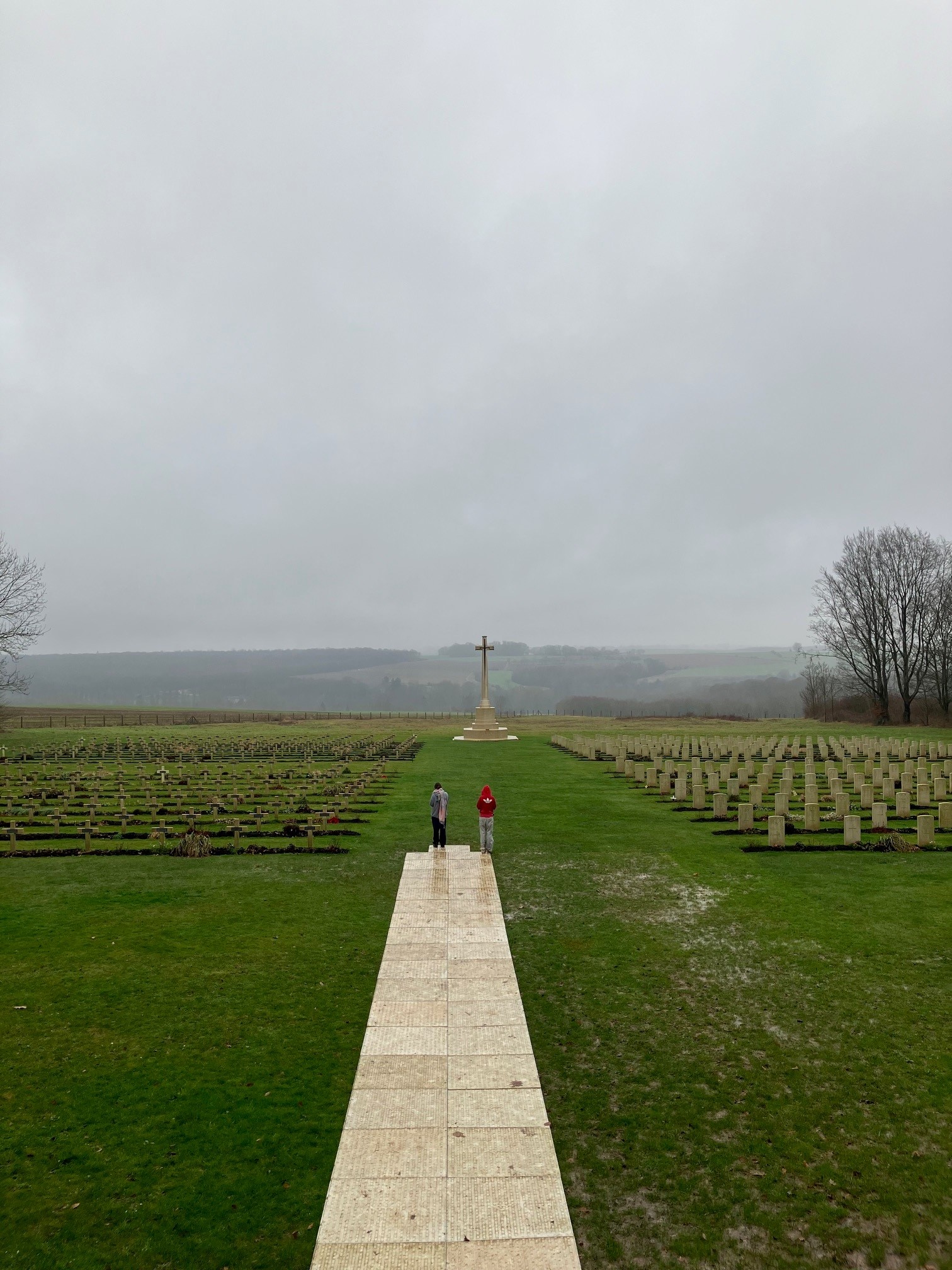
This week, Block 3 students have been Belgium and France to visit the historic battlefields which are a stark reminder of the impact of war, as the resting place for hundreds of thousands of servicemen who were killed in combat in World War I. Having focused on the war, anthroposphere, conflict and ethics in their humanities subjects this term, the trip gave students an opportunity to reflect on the historical, cultural and ethical aspects of their studies. 

On the first day, students visited Essex Farm, which famously moved John McCrae to write the poem In Flanders Fields while stationed there in 1915. They also visited Tyne Cot, the largest Commonwealth war cemetery in the world in terms of burials, and Langemark, where nearly 24,917 German servicemen are buried. Ending the day at Menin Gate, which bears the names of over 54,000 servicemen whose graves are not known, Felix Albizua and Alice Rawlence laid a remembrance wreath on behalf of Bedales.

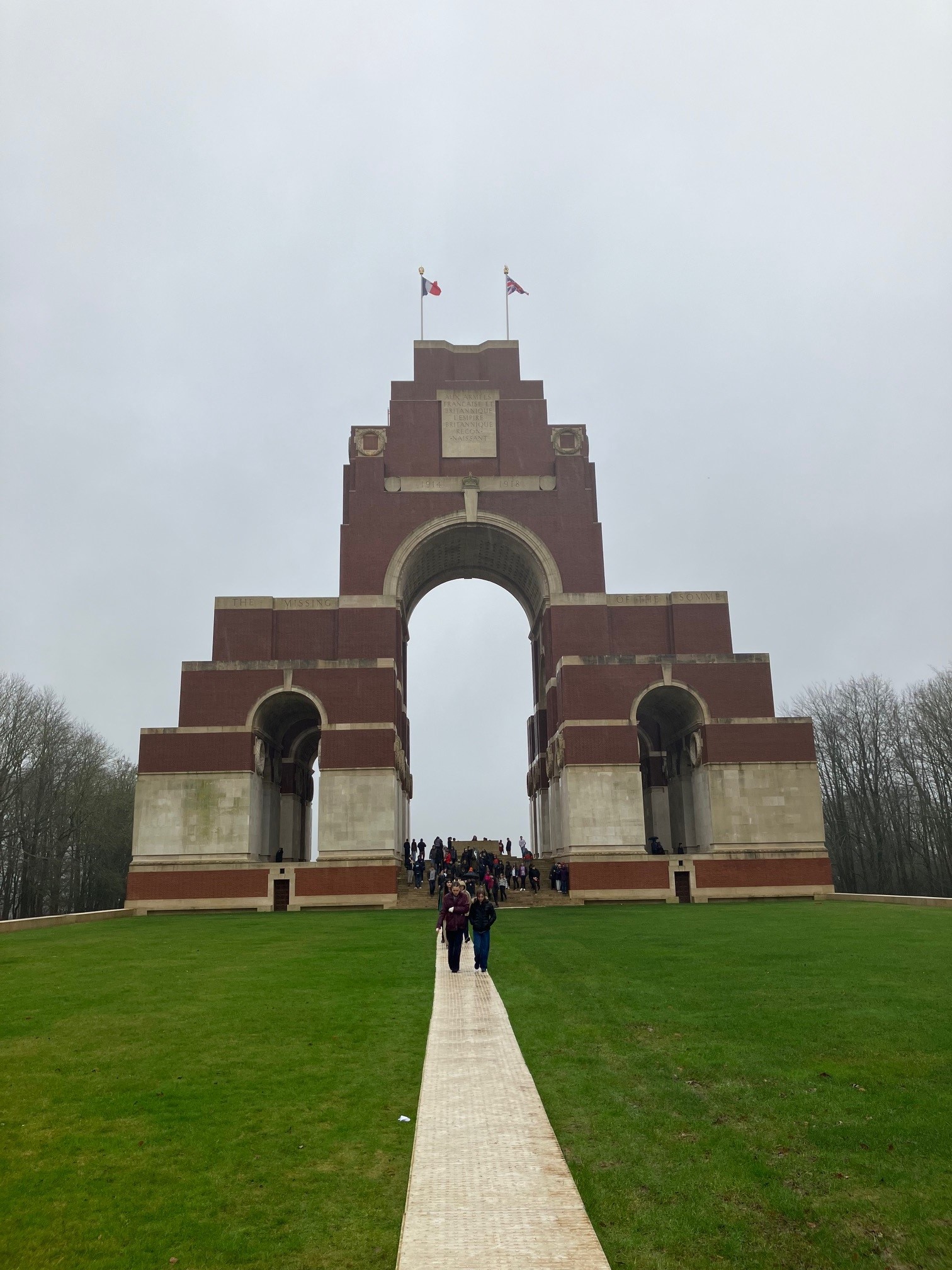
The following day, students visited Vimy Ridge, where the four divisions of the Canadian Corps fought side by side in the Battle of Arras in 1917, and the 36,000 Canadian servicemen who lost their lives in World War I are commemorated. They then visited the Somme, taking in Beaumont Hamel, Newfoundland Park, the Thiepval Monument and Lochnagar Crater. The Battle of the Somme was one of the largest and bloodiest battles of the war, with over 57,000 casualties on the first day, and over 150,000 British troops buried in the battlefields. The Thiepval Monument bears the name of over 72,000 servicemen of the United Kingdom and South African forces who died in the Somme before March 1918 and have no known grave.

After a cold and damp day which concluded the trip, we made an eagerly awaited stop at a chocolate shop, conscious that the weather, fatigue and discomfort was a mere fraction of that experienced by those who fought on the battlefields over 100 years ago. 

See more photos from the trip below.

Learning from History – from Hitler to pandemics

By Magnus Bashaarat, Head of Bedales

On Monday evening, historian Tim Bouverie came to Bedales for our second ‘real live’ Civics of the term. It was Tim’s first live gig since lockdown, and he was visibly pleased to be speaking to a real rather than virtual audience. It was a socially distanced audience, but a well- attended talk, and showed Bedales living with COVID, and not cancelling.

Tim’s 2019 book, Appeasing Hitler: Chamberlain, Churchill and the Road to War was what he came to talk about, but the questions in the second part of the talk ranged far and wide. Was there any similarity between the democratic world’s approach to Germany in the 30s and democratic Europe’s current approach to China? To what extent does personality rather than political pragmatism drive the decision-making that elected leaders execute on our behalf? To what extent did public schoolboy rivalries drive geo-political decision making: Eden was an Old Etonian, Churchill an Old Harrovian, Chamberlain an Old Rugbeian (I made that last one up, but let’s look at the current Cabinet).

If Germany had ‘invaded’ Czechoslovakia in 1938 to annex the Sudetenland and then called a halt to its well established agenda of righting the perceived wrongs of the Treaty of Versailles, then Chamberlain would have been hailed as a hero, another world war averted, and his statue would be in Parliament Square, not Churchill’s. The appeasers would have been vindicated; the anti-appeasers cast into the dustbin of politics to write their memoirs in whatever was the acceptable equivalent for a shepherd’s hut in 1940.

History will judge our politicians’ reactions to COVID-19 similarly. Perhaps the lockdown sceptics will be vindicated; it was all a massive over-reaction to bad ‘flu’ and 10% of GDP was an unnecessary loss to the country. Or the COVID paranoiacs might feel, like Cassandra, that had their prophecies been heeded, the dead would be alive. Whatever position on the spectrum one chooses to adopt, there is evidence available to support one’s view. The weight of evidence doesn’t equate to the weight of argument, and its validity. Rather like the Brexit debate, the vehemence of commitment to a position is fast becoming a substitute for veracity.

Returning from long leave we’ve outlined our plan for two more closed weekends before our two week half term. I understand Churcher’s College, our close neighbours in Petersfield, have shortened their half term from two weeks to just one, and are operating the second week of half term as an online teaching week to have a sort of ‘semain sanitaire’ prior to the second half of term. This would go down like a rat sandwich, I know, at Bedales, amongst students and staff battling to keep it all together during these next two weeks. But it reflects the range of responses to COVID-19 restrictions that schools across the country are exercising.

Bedales’ current COVID restrictions aren’t as restrictive as those operated by some schools, and we’re positioned broadly in the middle of the spectrum. Our SAMBA II testing machine, which arrived on Thursday this week, should be transformative in how we can test students and speed up the awful and open-ended wait for the test result to arrive. And the wider school community of staff and their families can benefit from it too. Gavin Williamson’s avowed intent to keep schools open is predictably fatuous because illness, if it does strike in a school community, will mean teachers unable to teach, as opposed to students unable to attend.

If the dreaded 14 day isolation is visited on anyone over the next few weeks then Bedales parent Adrian Wooldridge’s book, The Wake Up Call: Why the pandemic has exposed the weakness of the West and how to fix it, would be a good read. As a global index, the bigger the state machinery: the lower the death toll.