Volunteer tutoring with less advantaged pupils

By Rob Reynolds, Action Tutoring Volunteer, and Director of External Relations, Bedales School
In my role overseeing partnerships at Bedales School (an independent coeducational boarding school), I was keen to explore additional ways we could respond to the COVID pandemic in supporting young people. The school already had in place successful partnerships: we worked with a local primary school, providing additional classroom space for them to keep their bubbles apart, and providing a willing workforce and materials to improve the outdoor landscape. We have an ongoing collaboration with a local state academy on a variety of academic projects including hosting a ‘Question Time’ event with our East Hampshire Member of Parliament, students and head teachers which was switched to online delivery this year, and collaborating on Teacher Assessed Grades. Early in the pandemic, our Catering Manager introduced a food delivery service for vulnerable people in the local community, sourcing and delivering essential food supplies. We even offered a library service to give people access to fresh reading material.

Having heard in November 2020 of the launch of the Government’s National Tutoring Programme (NTP) to support disadvantaged pupils to recover from the educational disruption caused by COVID, I decided to research tutoring options. Even before the crisis, disadvantaged pupils were, on average, already 18 months behind their non-disadvantaged peers by the end of secondary school. Projections suggest school closures will widen this gap further; many of the factors that feed into this inequality have been made much worse by the pandemic. For months while schools were closed, children and young people did not have equal access to learning and, for many, the structure and spaces that support their development and wellbeing suddenly disappeared.

I registered as a volunteer with Action Tutoring, selected as a Tuition Partner for the NTP. Action Tutoring is a national education charity supporting pupils to achieve a meaningful level of academic attainment, helping them to progress to further education, employment or training. Specifically, their focus is on improving the grades of individual pupils: for the first half of the 2019/20 school year, Action Tutoring pupils made an average of 12% progress from their initial assessment, sat at the start of their programme, to their progress assessment six months later.

Although I am not in a teaching role at Bedales with responsibility for communications, alumni relations, partnerships, the Duke of Edinburgh Award and oversight of marketing and fundraising, I was keen to put my maths degree to good use by making a contribution, and also testing out this method of online tutoring as a possible route for other members of the Bedales community to contribute. In my early working life I was a naval instructor officer teaching maths to trainee engineers. I subsequently completed the training provided by Action Tutoring where I met (online) a variety of other volunteers including undergraduates, accountants, and serving and retired teachers. Training included a familiarisation with Action Tutoring’s chosen virtual learning platform, Vedamo, safeguarding training and of course, undergoing the necessary Disclosure and Barring Service (DBS) checks to work with young people.

Prior to the pandemic, Action Tutoring operated in specific geographical areas of the country where they had identified the greatest need for learning support and were well positioned to be able to pivot to online tutoring which enabled them to reach more schools and young people. Action Tutoring’s latest impact report which covers the period at the start of the pandemic highlights that in autumn 2020 it had over 80 online programmes underway, as well as delivering face to face. With the school closures in early 2021, the charity was able to quickly adapt its provision so that over 130 schools had online programmes up and running in a matter of weeks, providing tutoring support to pupils whilst they were at home.

Having completed all my checks, I was keen to get underway and was quickly allocated a state school in Chester supporting students taking GCSE Maths. Action Tutoring has developed the necessary resources to ensure a consistent quality of tutoring, which helped me familiarise myself with the curriculum and dust off any maths cobwebs. They also provided a local coordinator to act as the liaison point with the school and to work with the teachers to supervise the actual tutoring sessions which took place online at school, but after school had officially finished. In my case, that meant a weekly commitment tutoring two Year 11 students initially for an hour on Fridays from 3–4 pm, which was then increased to 1.5 hours.

Once the initial cohort of students had finished their GCSE Maths, I was then put to work with Year 10 pupils. The significant disruption for students and schools over the last 18 months encouraged Action Tutoring and the school to see how else they could support their pupils and a couple of catch-up Saturday morning virtual sessions were introduced from pupils’ homes, under the supervision of their parents.

I found the whole experience extremely rewarding. There were certainly challenges. It was difficult to establish rapport and really help the young people if they struggled with their own motivation to be doing extra maths outside lessons! The time seemed to fly by in sessions, and we also had to cope with connection difficulties, but I always took the view that these young people were going to benefit by actually doing maths during these periods rather than something else. We persevered, and by the time the programme finished for the Summer holidays, I felt the pupils were responding well and benefiting from the experience of this extra maths support. I think they appreciated that there were people out there who wanted to supplement their school work with their regular teachers to help them achieve their full potential. Seeing the young people benefit from this extra time and effort also gave me my own sense of achievement.

In terms of the funding of the NTP, Action Tutoring charges schools a fee for the cost of running its programmes, which is heavily subsidised by its own fundraising. Last academic year, the schools receiving the tutoring service contributed 25% of the cost of the programme, with the remainder covered by government funding through the NTP. Volunteers like myself are unpaid but Action Tutoring clearly has expenses such as developing teaching resources, running the virtual learning platform, staffing, and volunteer on-boarding.

Action Tutoring specialises in providing maths and English support at GCSE and primary levels. If you feel able to help, I thoroughly recommend it and you can find out more on their website here: https://actiontutoring.org.uk/. The whole process of volunteering is pretty smooth and you will soon be set to work helping hopefully keen young pupils. And for those of us who are not regular teachers, it gives us a taste of how rewarding and enjoyable educating others can be.
Century of Players Around Bedales Schools

This article was originally published in the Old Bedalian Newsletter 2021.

By Alastair Langlands, Staff 1973-2001

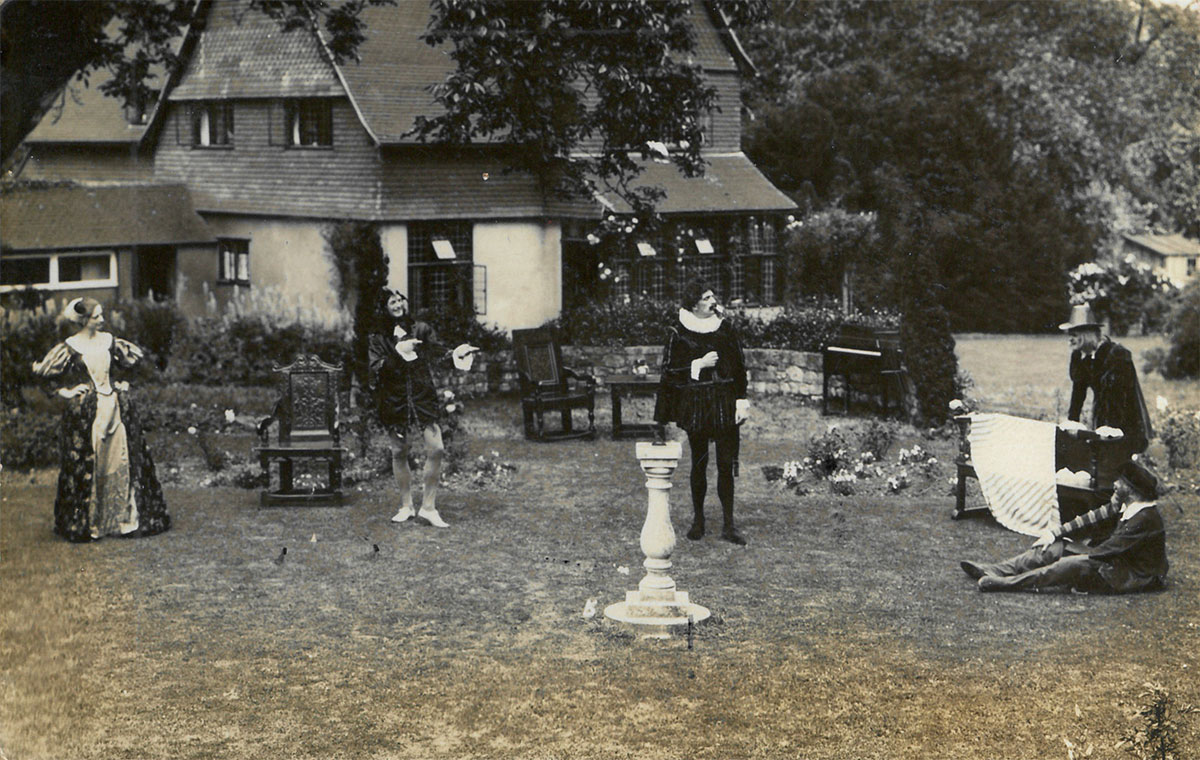
‘Twelfth Night’ in the grounds of Bedales, 1923

Roger Fry (later to become a Bedales parent) painted the backcloth for Macbeth, the first annual play. “From its earliest days, Bedales paid much attention to dramatic activities and the Chief’s productions of Shakespeare’s plays were memorable events for participants and audience alike. Though he had no theatrical experience he created and maintained an interest in plays and everyone became keen and fond of it.” (A Journey in My Head, Geoffrey Crump, staff, 1919-45).

Geoffrey came to Bedales in 1919, was appointed senior English master in 1922 becoming the first head of a fully-fledged English department in a school the size and status of Bedales. He insisted that if possible, at least one Shakespeare play should be acted by the older children every year, preferably with some of the staff acting with them. His enthusiasm led in the summer of 1923, with the permission of the Chief, to a production of Twelfth Night on the lower lawn of the garden at Steephurst; the cast consisted chiefly of local people, Bedales staff and Old Bedalians.

The triple arch of Steephurst porch, with a balcony facing south, appealed to Geoffrey as a suitable setting for Romeo and Juliet and there in 1926 he established Steep Shakespeare Players. He needed two years to prepare properly and to secure an adequate cast. He decided on Much Ado about Nothing for 1928.

“An incursion, however, in the month of June of a quantity of handsome young men in magnificent costumes was too much for some of the girls and the scale of the production as a whole caused an undue amount of disorganisation in the life of the school.” So, after Henry IVth, Part One in 1930, the Players moved a mile away, down to the gardens of Lord Horder’s Ashford Chace with his lordship as cordial president: Twelfth Night in 1932. These became monumental productions. The stage set was magnificent, the lavish costumes by Henriette Sturge Moore (1919-25) and a princely cast fitted neatly into Shakespeare’s roles which had been hallowed for centuries.

Players appeared from all over the land. Donald Beves, Vice-provost of King’s College, Cambridge (often spoken of as the finest amateur comedian in the country), lauded by George Rylands of The Marlowe Society, starred as Malvolio and Friar Lawrence and Geoffrey himself as Capulet and Falstaff. Starring was something Geoffrey promoted and here something conspicuous occurred: performances attracted The Times Theatre Critic with sometimes a half page photograph of the cast or a star, Tatler, Telegraph, Sketch, Sphere, Petersfield Post, Hampshire and Sussex News, Hampshire Chronicle and Portsmouth Evening News. There were players from OUDS in Oxford and ADC in Cambridge and the Royal Academy of Music. Joanna Dunham (1949-52) and Tessa Mayor (1929-34) were among pupils who starred. They were accompanied by Harold Gardiner (staff, 1952-68), Basil Gimson (1896-1904; staff, 1911-1947), John Slater (staff, 1952-67), Anthony Gillingham (staff, 1946-70), Robin Murray (1953-59), Christopher Weisselberg (1954-61), Bert Upton (estate staff), E L Grant Watson (1895-1904) and Roger Powell (1907-1915) with music by Harry Platts (staff, 1937-46) and Roland Biggs (staff at various times between 1923 and 1967).

An archive of large albums (12 x 16 inches), lovingly assembled to survive the Players, stylishly portrays spectacular scenes and actors. It would (of course) take Geoffrey two whole years to prepare such handsome shows (where interval tea was provided by the ‘Petersfield Tea Shop’, price 9d).

The ambition and success of Steep Shakespeare Players and the splendidly designed and extensive stage structures, by Gigi Meo (1923-40) and then Christopher Cash (1950-78), were swamped by post-war restrictions and finances.

They made an annual loss. Geoffrey had targeted Shakespeare and from 1923 managed 23 productions finishing in Ashford Chace with The Tempest in 1961. He saw the play as Shakespeare’s farewell to the stage and his own regretful farewell to Ashford Chace. He was no longer able to fund these sumptuous productions.

Local press headline ‘Find a home for them on the heath’ badgered the council to action but it was Mary More Gordon (Bedales parent) picking up the threads in 1964 who approached Arthur Gill, the owner of the beautiful Ecclesiastical Court House in East Meon. She inquired if he were willing for his 14th century hall to be used as a small theatre. He was content to have his vast hall filled with a massive structure of tiered seats. The Players had found a fine new interior site. Now called The Court Players they introduced variety. Geoffrey’s last show was Everyman and A Phoenix Too Frequent in 1965; then followed Bae Lubbock’s assistance in Anouilh’s Antigone, Peacock’s Nightmare Abbey, Strindberg’s Creditors, Shaw’s Arms and the Man and finally Chekhov’s Uncle Vanya, Paul Townsend (staff, 1957-64) and Kate Slack (staff, 1962-74), wife of the headmaster appearing.

‘Romeo and Juliet’, Ashford Chace Garden Theatre, 1953

Bedales staff at this time put on frequent staff plays with Ruth Whiting (1963-2000), Geoffrey Robinson (1949-80), William Agnew (1967-78), Tim Slack (1962-74), George Smith (1959-81), Anne Archer (1971-77, 1986-2008), Philip Young (1971-74 and 1977-2007) and John Batstone (1968-93) and others involved.

But it was the extra mural playing which would not cease: active and valuable members of the company, Kate Slack and Mary More Gordon, assumed organisation in 1978. Still at the Court House, with Arthur Gill’s keen interest, they put on John O’Keeffe’s Wild Oats (1791) which had been revived by the RSC in 1976. Jane Bevan (staff, 1977-83), Nicholas Wood (1974-81), Jessica Cecil (1980-82) and Victoria Chester (1978-80) and players from the erstwhile Court Players’ productions, took part with local amateurs in East Meon. There followed George Colman’s Clandestine Marriage, Pirandello’s Henry lV, Ibsen’s Enemy of the People (with music by Philip Young) and Turgenev’s A Month in the Country.

After Arthur left the Court House, we left too to lodge in Mill Court, Binsted, a fine malmstone barn with a queen-strut roof which could be cold and audiences were encouraged to arrive with a blanket. Twelfth Night was first in 1988 with OBs Phyllida Hancock (1973-80) and Nick Tier (1982-86). To avoid royalties Kate put on a revue We’re Court on the Hop, followed by William Douglas Hume’s David and Jonathan, Stephen Poliakoff’s Breaking the Silence. Isobel Ballantine Dykes (staff, 1983-89), Paul Townsend and John Batstone, Victoria Chester, Will Rye (1987-89), Kate Day (née Fairweather, 1978-85), Polly Wreford (1973-80), Richard Quine (1981-86), Caroline Rye (1983-85), Christian Taylor (1981-86), Lucia Gahlin (1986-88) and Sarah Hulbert (1984-86) with musicians Hannah Rogers (1979-86), Alexandra Harwood (1970-84) and Kristina von der Becke (1978-85) appeared. On each occasion it was necessary to construct a stage and audience seating. It was clear to Kate that the Players were looking for a permanent playhouse.

Lord Bessborough had been a semi-professional actor during his time in Canada. He was chairman of the Chichester Festival Theatre which under the directorship of Laurence Olivier was to become the foundation of the National Theatre. In Stansted Park, Bessborough had recently installed a theatre in the stables replacing one of the 1920s destroyed during the war. Here, at Bessborough’s invitation, the Court Players performed three of Chekhov’s short plays. Chekhov was followed at Stansted by Simon Gray’s Quartermaine’s Terms.

Bessborough was extremely eager to have one of his own several plays performed in his new theatre (designed by Peter Rice, parent) which seated 100; he asked me to produce a dramatic reading of his King of Gods. I employed Bedales pupils Georgia Malden (1985-90), Esther Godfrey (1989-91), Helen Isaac (1986-91), Jossy Best (1989-91), Emma Jenkins (1986-90) and staff and the professional Tony Britten who was a friend of the Bessboroughs. This was in 1990 to an audience invited by the host. As a result, I was invited to take the name of the company The Stansted Players, founded by the ninth earl in 1929 but eclipsed by the outbreak of war.

The Stansted Players’ productions have differed from the reverent canon followed by predecessors: I have endeavoured to find plays which have never before been performed (The Noble Jilt, by Anthony Trollope) or have once been popular but fallen into desuetude (George Lillo’s The London Merchant: it was performed annually for 100 years until c1850). These plays cannot be desecrated by reducing the length to One Act of 90 minutes and including four-part songs. We meet at Sparrow’s Hanger in Selborne for 10 days of rehearsal in the theatre.

We played at Stansted Park until that theatre, following the death of Eric Bessborough, was converted into offices in 2000, our last choice being Shakespeare’s Hamlet the bad quarto.

A theatre group ETC, for OBs to meet at school and perform, managed two productions: in April Barney Powell’s (1991-96) The Cherry Orchard and then in September 1999 with Daisy Parente (1997-99) directing The Memory of Water with Lisa Jackson (1992-97), Lydia Leonard (1995-99) and Georgina Hutchinson (1994-99) and some 40 other former pupils. Support was not, however, forthcoming in the following year.

This collapse of ETC bereft the school of OBs returning to play and consequently the Stansted Players were invited to the newly erected theatre drawing an audience shortly before the start of the Autumn term. Since 2001 we have been made welcome and comfortable. When the theatre was under repair we were invited to use the Lupton Hall, before its recent refurbishment as a concert hall, with St John Hankin’s The Cassilis Engagement; the last of four performances was fully booked for a 60th wedding anniversary.

The Stansted Players have never sought stars but rather have given Bedalians opportunity to enjoy themselves for a fortnight during the summer. Staff took part in early plays: Geoffrey Robinson, Paul Townsend, Caroline Walmsley (1981 and 1990s), Graham Banks (1980-2013) and Jonathan Taylor (Deputy Head, 1996-2004) but it is pupils who have peopled the productions. The now familiar singing began with Amanda Boyd (1987-89) as soloist marking the intervals of Lady Audley’s Secret, a performance which began with the National Anthem in the days when an audience was perfectly tuned to stand respectfully. Thereafter the Players have been included for their singing qualities.

Dan Wheeler and Natasha Ruiz Barrero in ‘Two Noble Kinsmen’, Bedales Theatre, 2004

Over the three decades about 75 Bedalians have appeared on stage and some have proceeded to a professional career in music or drama: Johnny Flynn (1996-2001), Dan Wheeler (1995-2000), Jack Finch (2003-08), Esther Biddle (1994-99), Elizabeth Bichard (1996-98), Natasha Ruiz Barrero (1996-2001), Grace Banks (1998-2003), Gabriel Bruce (2002-07), Stephen Davidson (2000-05), Anna Dennis (1994-96), Dominic Floyd (1997-2002), Simon Gallear (1991-96), Jo Horsley (1994-99), Sofia Larsson (2001-06), Katie Manning (2000-05), Beth Murray (1986-89), Jo Tomlinson (1997-99), Bart Warshaw (1996-01), William Wollen (1987-92), Olivia Brett (2006-14). The plays have included more than 100 four-part songs dating from C14 to popular music of the present day and it is this playing-and-singing that attracts audiences. An essential part of every production has been the musical arrangements of Nicholas Gleed (staff, 1990-2017) and lighting by Janet Auty (staff, 1990-2015). Each year, towards the end of August, the Stansted Players return to the school, lying in the orchard and rehearsing in the theatre.

  • 2020 p l a g u e
  • 2019 The Watched Pot (or The Mistress of Briony) by Saki, 1911
  • 2018 Green Stockings by A E W Mason, 1911
  • 2017 Speed the Plough by Thomas Morton, 1798
  • 2016 The Princess Zoubaroff by Ronald Firbank, 1920
  • 2015 The Master of Mrs Chilvers by Jerome K Jerome, 1911
  • 2014 The Good-natured Man by Oliver Goldsmith, 1750
  • 2013 The Cassilis Engagement by St John Hankin, 1907
  • 2012 Gretchen by W S Gilbert
  • 2011 The Foresters by Lord Tennyson, 1881
  • 2010 A Double Falsehood or the Distressed Lovers by William Shakespeare and John Fletcher, 1727
  • 2009 The Bells by Leopold Lewis 1871 & (world première) Jack o’ the Cudgel by William McGonagall, 1870
  • 2008 A Fair Quarrel by Middleton and Rowley, 1616
  • 2007 World Première Barchester Revisited by Simon Raven, 2000
  • 2006 (first staged production) A Noble Jilt by Anthony Trollope, 1850
  • 2005 The West Indian by Richard Cumberland, 1730
  • 2004 Two Noble Kinsmen by William Shakespeare and John Fletcher, 1612
  • 2003 Vortigern and Rowena by W H Ireland, 1790
  • 2002 The Princess Zoubaroff by Ronald Firbank, 1920
  • 2001 The Tender Husband by Richard Steele, 1720
  • 2000 Hamlet (the bad quarto), 1600
  • 1999 Daisy Miller by Henry James, 1900
  • 1998 Pygmalion and Galatea by W S Gilbert, 1885
  • 1997 The Frozen Deep by Wilkie Collins and Charles Dickens, 1850
  • 1996 Our American Cousin by Tom Taylor, 1860
  • 1995 The Lady of Lyons by Lord Lytton, 1850
  • 1994 The Frantic Stockjobbers by William Taverner, 1750
  • 1993 Lovers’ Vows by Kotzbue, 1798
  • 1992 The London Merchant by George Lillo, 1745
  • 1991 Lady Audley’s Secret by CH Hazelwood, 1850

2023 will be the 100th anniversary of the Players descending directly from the Steep Shakespeare Players via the Court Players which Kate Slack bequeathed (with a cheque for £74) to the Stansted Players.

New and improved Petersfield Museum

This article was originally published in the Old Bedalian Newsletter 2021.

By Alice Shaw (née Sedgwick, 1992 – 1999)

Alice and Lead Trustee Bill Gosney (far left) and the construction directors, July 2019

After spending most of my time in the Bedales Art Block, I left in 1999 to study Art History at the University of York followed by a Masters in Museum Studies at the University of Essex. I always knew I wanted to be around art but was realistic about my own abilities not to rely on making a living from it!

After graduating I worked at the British Museum and V&A in temporary exhibitions, then at the Science Museum on permanent galleries and capital projects. In 2015, my family and I left London and moved back to Steep in search of space and fresh air for our two young boys. At this point it felt inevitable that my career in museums would be put on hold while our family grew up.

Soon after, however, I heard that the local Petersfield Museum, which opened the year I left Bedales, had recently purchased the adjoining Police Station. It also received a grant from the National Lottery Heritage Fund to renovate its existing building in the Old Courthouse, and design and build new galleries, collections facilities, exhibition and learning spaces and a courtyard café. I felt strongly that this project and I shared a destiny, and was delighted to be appointed as Project Manager in December 2016.

My job was to engage and lead a design team to deliver the museum’s vision of being at the heart of local life and also offer a compelling attraction for visitors from further afield. The historic Victorian buildings combined with striking architecture will create welcoming social areas and stimulating learning spaces. It will be a family friendly space that will inspire visitors of all ages to investigate the region’s many historic and cultural assets and to explore the surrounding countryside.

During the design development process, it was proposed that a map of the South Downs National Park be inlaid into the surface of the courtyard. This is made of granite slabs showing Petersfield and surrounding villages represented by brass and stainless steel icons. Some will be easily recognisable to those who know the area but some are more obscure so accompanying interpretation will be used as a guide to explore this striking artwork and the local area. This was all designed pre-COVID, but now offers a safe way to access the museum in an outdoor setting. Visitors can enter the cosy courtyard for a coffee and enjoy the wide-ranging, engaging collections and diverse educational and events programmes.

The team celebrate the end of construction, November 2020

The new and improved Petersfield Museum will tell the story of this ancient market town and surrounding villages through objects, art, literature and dress produced or collected by its residents. The collection includes the work of local artist Flora Twort and archaeology from prehistoric barrows on Petersfield Heath. Forming a significant part of the collection is The Bedales Collection of Historic Dress donated to the museum in 2007. This includes over 1,000 items from the 18th century to modern day and was built up over a 50-year period by the school, and particularly by music and drama teacher Rachel Cary Field (staff, 1941 – 1975).

The collection mirrors 250 years of social and cultural change and includes rare and nationally significant pieces, including an item recently loaned to the Design Museum for the ‘Women Fashion Power’ exhibition. A number of garments have strong local provenance and the great majority of the collection formed part of the Bedales Wardrobe.

Of the dresses, an aesthetic, Liberty style, cream silk dress from the mid-1890s is particularly rare, as are comparable Arts and Crafts garments from the early 1900s. Such ‘countercultural garments’ survive in small numbers, with the V&A, Museum of London and Platt Hall, Manchester holding most of the few surviving examples.

The museum also holds a nationally important collection of some 2,000 books by and about the renowned poet, writer and Steep resident, Edward Thomas (1878-1917). Like so many others, and this is still so true today, the Thomas family were attracted to this area by three things: its direct rail link to London, its countryside and, of course, Bedales, which Edward’s wife Helen knew of before it relocated from Haywards Heath in the early 20th century.

The Poet’s Stone

The collection is held within a new Edward Thomas Study Centre which is open, by appointment, to students, readers, researchers and visitors, who can explore his work and then the wonderful landscape around us that inspired him, and many others, so much – and continues to do so. Edward Thomas is amongst the War Poets commemorated in Westminster Abbey. The Poet Laureate Ted Hughes considered Thomas to be “the Father of us all”, and his life and work is included in the National Curriculum. Thomas’ time living in Steep coincides with a critical phase in his life when he made the transition from literary critic to poet.

Thomas’ connections to Petersfield are important to understanding his life and work, which features and interprets the countryside of Hampshire, the South Downs and the south of England. Amongst items on display, or available to view, in the Edward Thomas Study Centre is a copy of one of his daughter’s Bedales exercise books, in which he has drafted three poems.

The Petersfield Museum’s courtyard, looking across to the café and Edward Thomas Study Centre

In the museum’s final gallery, visitors can see a film of original footage shot on location in Petersfield and the surrounding area, capturing the local diversity of architecture, history, landscape, wildlife and culture. This includes shots of both the Harrow Inn and views from the Poet’s Stone, which many of you will be familiar with. The stone is a memorial to Edward Thomas, which is still the subject of regular walks from both the main school and Dunhurst and Dunannie.

What makes this film so special, emotive and rooted in the area, is that it is overlaid with a recording of Daniel Day-Lewis (1970 – 1975) reading Thomas’ poetry, the use of which was permitted by the Poetry Archive.

Like so many things, the pandemic has delayed the opening of the museum, but we very much hope that doors will open to the public later this year. Working at the London national museums was infinitely inspiring, exciting and challenging, but having the chance to be part of the team to create a museum in my hometown, is a dream come true.

The new and improved Petersfield Museum opened to the public in June 2021. Tickets can be booked in advance online at the Petersfield Museum website, or at the Welcome Desk as you arrive at the museum. The museum is open Wednesday – Saturday, 10am – 5pm, and Sundays and August Bank Holiday, 11am – 4pm.

Pedalling for a bright future

By Tess Burrows, Old Bedalian

Bedalians have always been brilliant at being the change, shining a light bravely for others  to follow. Never has this been more important than now in the current climate crisis.

I’m sure you are aware that if we don’t collectively and urgently make changes, our world will rapidly become uninhabitable.

Please would you write a Climate Action Pledge promising what you personally can do as an extra commitment to make a difference at a global climate level?

Every positive action help. Think planting trees or cutting down on fossil fuels, eating local plant-predominant foods, or many other ways of cutting your own carbon emissions…

Complete your Climate Action Pledge on this form, and return it to me at tessburrows@yahoo.co.uk.

I am proud of my Bedales education, which I believe gave me a springboard to tackle seemingly impossible challenges to help our world. In the last 20 years, I have carried messages to the far points of the planet for peace. This Autumn, I have committed to carry Climate Action Pledges to COP 26, the United Nations Climate Summit in Glasgow, to lay at the feet of world leaders.

The journey will be 600 miles on my old mountain bike weighed down by camping gear, along with a friend and my granddaughter. I am very slow on a bike – I average not much more than four miles an hour! But we hope to inspire thoughts of getting around without using fossil fuels at whatever age. I am 73 and my granddaughter is 13.

Thank you for your support.

If you would like to sponsor us, we are raising funds for three environmental charities: Protect Our Winters (Climate Change Action), Sustrans (UK Cycling Network) and World Wide Fund for Nature (Save Tigers from Extinction). Five inspirational adventure books are also available to purchase on my website, sales in support of the above charities.

More info tessburrows.org/blog/pedalling-for-a-bright-future.

New season of Bedales Events

By Eve Allin, Bedales Events Programme Coordinator

Thank you for your support of the Bedales Events programme over the past year. We are delighted to announce that we are returning in the Autumn Term with a full programme of events. The new season brings the sunshine inside with a packed line up of live performances. Let’s celebrate our collective love of the arts: come and watch comedy, music, theatre, and poetry right on your doorstep.

After what will be nearly 18 months of the live arts sector being closed for business, we are jubilant at the prospect of bringing events back to Bedales. We are confident you will enjoy this season as much as we enjoyed creating it. You can book your tickets for the Autumn season now at bedales.org.uk/events.

Starting off with an old favourite, Hackney Colliery Band are ready to raise the roof with their foot-stomping covers and original music. Later in September, the HandleBards are cycling over to us, set and costume slung over their shoulders: bring your picnic blankets for their all-female, outdoor version of Macbeth. Red Fox Theatre bring the warmth of a traditional pub theatre to the Lupton Hall, combining music and puppetry with captivating storytelling in Catch of the Day.

The best and brightest in the country join us for talks and lectures including furniture maker and industrial designer Sebastian Bergne, AI expert and co-founder of CognitionX Tabitha Goldstaub (OB) and inspirational headteacher Tony Hartney CBE. Families and young audiences are treated to a choose-your-own-adventure spectacular from friends of Bedales, Quick Duck Theatre. If it is comedy that piques your interest, but you are looking for an evening out after so many evenings in; The Noise Next Door are back again to entertain, enthral and surprise.

As the nights draw in, Phosphoros Theatre arrive to ignite our hearts and minds – ‘All the beds I have slept in’ is an insightful and stirring piece of theatre made by lived experience refugee performers. Cecilia Knapp, Poet Laureate for London, returns to Bedales in November to spend an evening reading poetry, answering questions and teaching students. Benny Wenda joins us for the annual Global Awareness Lecture – this talk has been an opportunity delayed and we are very lucky to have Benny joining us in December.

Woven in between all these brilliant visiting artists is our renowned Home Grown work – two school shows, two contemporary music events, four classical concerts, and two Theatre Studies exam pieces. These are performances created and staged at the heart of Bedales by the wonderful students that study here.

Standing for Steep Parish Council

By Andrew Martin, Head of Outdoor Work

Bedales has a long and proud association with Steep Parish Council. Over the years many members of our Bedalian community have been elected councillors and this year I am currently in the running to join them…

For the last seven years I’ve lived on the Bedales estate where I manage the school farm and teach Outdoor Work. Steep is where I live and work and where my children go to school.

One of the key things I teach our students is how to live and work together. Whilst we devote much time to environmental aspects such as animal husbandry, farm-to-fork education, planting hedgerows, growing, land management and traditional craftsmanship, we also look at the social aspects too. These include how to live respectfully and happily in a close-knit community.

It has been a difficult few years for our village. Not just because of the pandemic, but also because of deep rifts over the Church Road land and the proposed development which has divided this wonderful Steep community of ours, which Bedales is very much part of.

Sitting on my couch getting cross with a Brazilian president about the Amazon rain forest is easy. Taking the time to meet with the parish council in a public consultation about the future of a patch of land requires some degree of effort. However if we encourage our students to ask questions, challenge ideas, to consider alternative views, listen to others and develop their own thinking. Then certainly I need to live what I preach…

I think I could contribute to an effective, sustainable solution, however there is a lot more to our community than this one, polarising issue.

For example, what could we do for our amazing Steep School? What could we do about traffic calming and making the roads safer? Access to green spaces? Strengthening the relationship between the schools, nurseries, and local residents? How could we build relationships between the young and the old?

I would like to help bring the community together, which is why I’m asking people to vote for me in the forthcoming Steep Parish elections.

I have a deep commitment to this community and a strong desire to see it come back together. I would love to be given the chance to make a difference in it. I believe I could put this experience to great use on the parish council.

Only a small number of you may be eligible to vote in these elections, however every little helps. Vote for me on July 15!

Farewell from outgoing Chair of Governors Matthew Rice

Valedictory letters aren’t much worth reading as… well… the writer is about to disappear in in a cloud of dust, but not to say thank you for having me feels rude so here is a thank you letter from your departing Head Governor.

I came to Bedales in 1975, the September before the hot summer when we sloshed water on our shirts before lessons, when the orchard was white as straw and when the pine trees made Steep smell like Provence. Mr Jacks, the school’s third headmaster came to visit; Tim Slack, the fourth was trying for a second time to be Liberal MP for Petersfield (he very nearly won); Roger Powell showed us how he was restoring a medieval Irish book in Froxfield and plenty of staff had been teaching long enough to have known our founder John Haden Badley.

Nearly 50 years on and plenty is unchanged, the Beechwood-Wooly hangers as backdrop and the mountain of Butser Hill to the South West and the wraparound green country that defines the school. In some ways the place is also unrecognisable as the last 20 years have seen the building of half of the school with the Orchard Building, the Art and Design Studios and now the Studies. But watching the students come out of Assembly it is hard not to see how very recognisable the actual body of the school is, and how the real continuum of Bedales remains its true and rightful owners: your children. Staff and governors, heads and chairmen steer and scheme but the heart of the place beats independently. It being Bedales, very independently.

In the 13 years that I’ve been on the Board (10 of them wearing the chief weasel’s hat), I have seen brilliant staff and children working together, watched staff building the roof of the pavilion, Old Bedalians restoring the Outdoor Work barn and building the loggia around the dining room, students involved in new designs for buildings and planting 40,000 daffodils. I have seen new giants arrive who will utterly inform your children’s lives like the great teachers of the past whose memorials have seen the Lupton Hall crammed to the gunwales with grateful students.

The late unpleasantness of COVID has made some of the joys of communal living seem hard to hang onto in these last two years but now we are (partly) back and lying in the orchard or bank, walking round the Mem Pitch and smelling those pines again.

Steve Nokes is taking over as Chair. He is an ex head and clever, wise and funny. You are in good hands I am sure of that. But more importantly in Magnus and Richard Lushington you have a team who make the school feel secure, impressive and progressive.

So thank you parents. Both for allowing me the actually huge privilege of doing this job for so long   but more importantly for choosing Bedales. Those hundreds of decisions form and sustain and populate my very best loved school and will provide the Bedalians and Old Bedalians and maybe Head Governors that will keep the show on the road.

Ave atque vale
Matthew

Bedales Dance and Drama – a year in review

By Hayley Cole, Head of Drama and Liz Wood, Head of Dance

Despite another challenging COVID year, the Dance and Drama department have had another incredibly busy and successful year and we wanted to celebrate those successes with you.

All components of the Bedales Assessed Course (BAC) and A Level courses were completed, including practical units by all students on the courses. Schemes of work were adapted and students made video projects as practical assessments in lockdown, and when we have been in school, performance assessments have been recorded as evidence and shared digitally rather than visited by external examiners, or in some cases, rather than being viewed and appreciated by live audiences. This really allowed the students to gain skills in areas that would not have looked at previously.

We have still put on four co-curricular productions, adhering to restrictions and delivered in different mediums – whether to a closed audience live, live-streamed and shared afterwards, or shared as an entirely digital production. Our peripatetic lessons have continued online and live, and exams have been taken. Our enrichment programmes have culminated in performances, with the students concluding the hard work they have put into it after pausing projects during school closure.

We have all learned new skills and adapted our skillset to navigate these uncertain times. Yet we have grown from it, consistently certain in our determination to stay creatively challenged and celebrating the area we love – the arts.

The Autumn Term included BAC Dance and Drama assessments. The Block 4 and 5 dramatists performed devised work influenced by Greek theatre and practitioners. The dancers worked on live performances in the style of a multitude of practitioners, from August Bournonville to Alvin Ailey. 6.2 actors performed their re-enactments of classic texts in the style of Brecht, Ad Infinitum and Forced Entertainment. The Autumn Production was Constellations by Nick Payne, a beautiful two-hander about a relationship, love and quantum physics. The artistic interpretation of this play was created due to COVID, and yet practically and artistically was so much more exciting because of those creative choices. Block 5 and 6.2 actors appeared in multi-roles, in duplicate casts, complimented by 6.1 dancers who personified the themes and emotions of the piece, through their use of movement. It was stunning and the chemistry of the actors was incredible, despite the metre plus distance between them at all times!

The Spring Term was a digital one. BAC Drama students performed their stories in The Terrible Infants as recordings, editing and adding live music in the style of Kneehigh. At home, the Block 4 dancers continued to work on the sofa dance, choreographing in their own homes ready to bring it alive, and the Block 5 dancers rehearsed group choreographies together online, for each of them to create a dance-film based on an array of different stimuli. The dancers also took part in online external practitioner workshops to keep them moving.

The 6.2s acted their naturalist Rotterdam as a screenplay and the Spring Production of Machinal was made in to a film. The students were sent green screens, rehearsals took place on Microsoft Teams, the crew researched costume, hair and make-up and the actors sourced it at home, filmed themselves and the footage was spliced together and edited to make the final piece. It was released episode by episode in half term but if you did not get a chance to watch it, click here to enjoy it, episode by episode, or all at once if you prefer! The playwriting enrichment writers also completed the 30-minute original scripts which were entered into the National Theatre’s New Views competition. 

The Summer Term saw us back at school collaborating together and attending the theatre once more. Bedales Dance Performs saw 21 of the dance pieces that the students had been working on over the year. They included performances from all year groups and including one of the modern peripatetic lessons. View and buy photos from Bedales Dance Performs here. The students were incredibly excited to get back into the Theatre and perform their work, and even though there was no physical contact within the choreographies, this did not stop them performing with passion, focus and commitment.

The A Level final evidence was collected and recorded. 6.2 dramatists created two incredible devised performances and performed a Berkoff piece in the studio and a Footsbarn site specific promenade performance. The two student directors finally picked their projects back up again and Nay Murphy’s Definition of Charisma (which was longlisted in the National Theatre’s New Views competition) and August Janklow’s True West were both enjoyed by closed audiences in the Drama Studio. The finale of the year, including a cast and crew of over 60, was Chariots of Fire, full of actors and dancers, which was incredibly well attended and well received at the end of term. 

A huge thank you from us to all the students and staff who have gone above and beyond to make all of the above possible and professional. It is your tenacity and talent that makes us so proud of the Dance and Drama department, especially in the face of adversity and we look forward to a new year, with all the new skills and insight we have gained. 

Bedales Summer Hockey Festival

By Kevin Boniface, Head of Hockey

Last Friday saw the culmination of the Bedales Summer Hockey Festival. This has run for six weeks in the Summer Term, with over 70 students signed up and good representation from all year groups. I think it is a real credit to Bedales Hockey that we are able to produce a culture that facilitates these opportunities. Week in, week out, it has been incredibly pleasing to see every single player and team consistently perform at a good level and striking the right competitive balance.  

Finals day was no different, with extremely close match ups in the semi-finals between Team Wheeler vs Team Mackillop-Hall and Team Upton vs Team Shuster. It was Team Mackillop-Hall and Team Shuster who came out on top and went on to produce a tight and exciting final that had to eventually be settled by a round of penalty shuffles. Congratulations to Team Shuster who eventually emerged as winner.

In another closely run competition the ‘Golden Stick Award’ for the festival’s top goal scorer – which featured an incredible 18 different goal scorers – was won by Block 4 student Joe Cullen.

Thank you to Mariela Walton, who was instrumental in the smooth running of the festival.

Parents’ Day Tennis Finals

By Graeme Coulter, Head of Tennis

On Saturday the finals of the intra school tennis tournaments were contested, with parents able to come and watch for the first time since the start of the pandemic. Six finals were contested over the course of six hours.

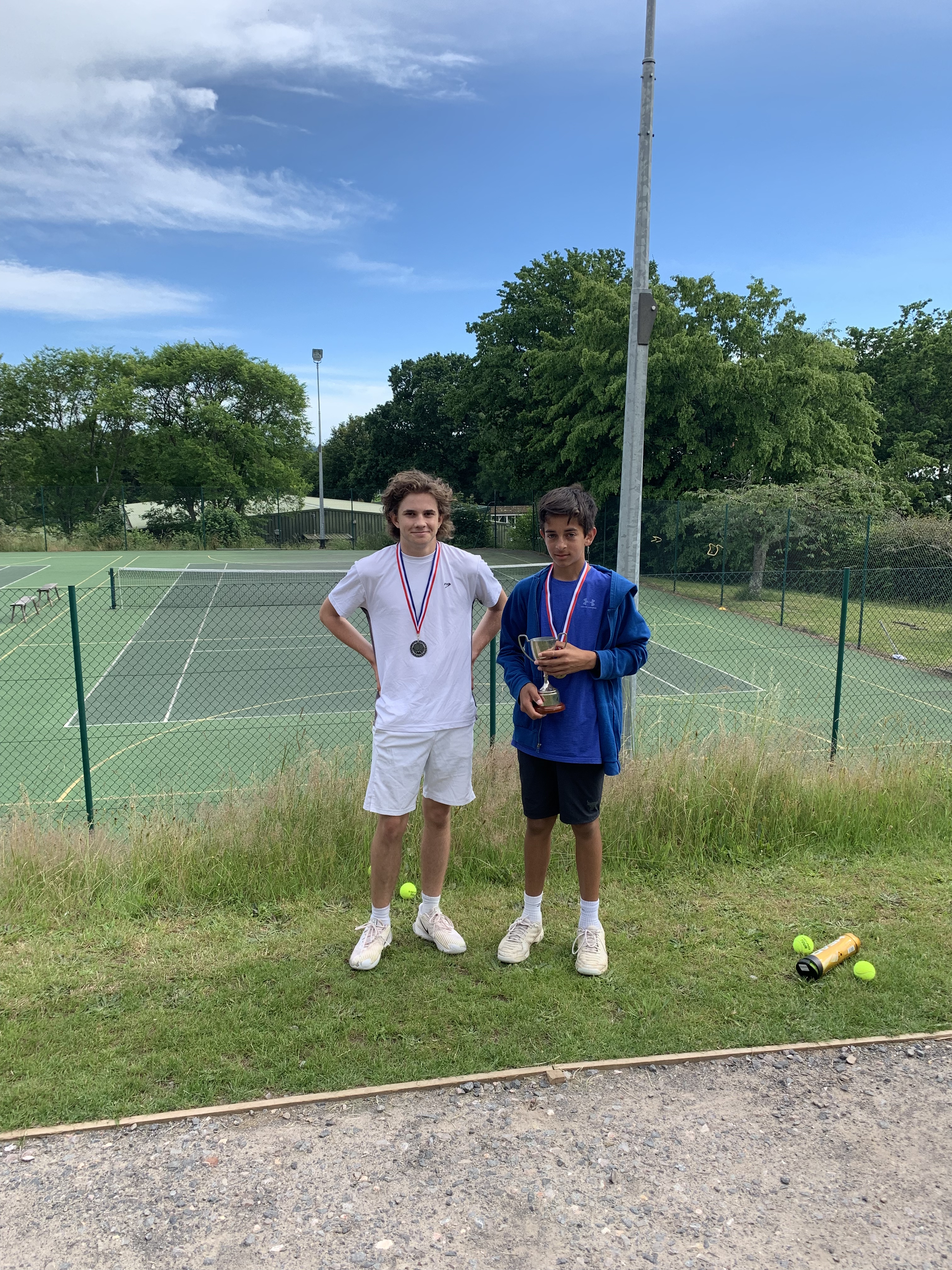
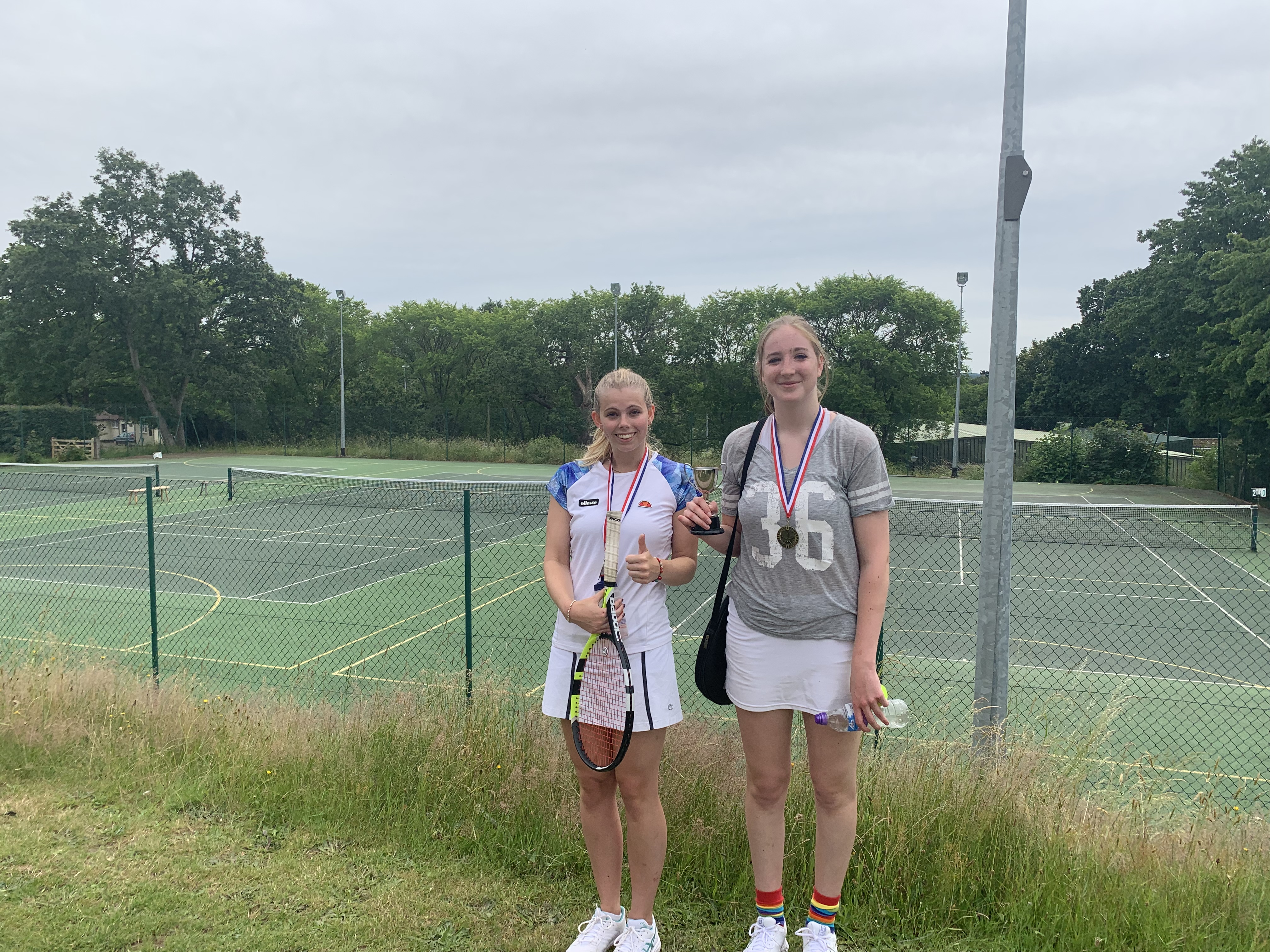
Harry Hornsby and Nikolas Beecham took on Hari Walton and Tommy Hornsby in the boys doubles. The youngsters from Dunhurst played to a truly outstanding level to win 6-0, 1-6, 10-5. The mixed doubles was very closely contested by Paddy Arrowsmith, Sasha Arney, Tobias Bonham Carter and Jade Mark. This final was a brilliant match where momentum flowed form one pair to the other. It was eventually won by Paddy and Sasha 6-4, 6-7, 10-5. Grace Vernor-Miles, Lally Arengo-Jones, Sasha Arney and Alisia Leach played the girls doubles final. This was another close match where either side could have won, but Grace and Lally held their nerve to win for the second year running 6-4, 7-6.

The junior girls singles was played between Lola Mackay and Rebekah Leach. This was an outstanding match and both girls showed amazing grit and determination to compete through injuries. Rebekah was victorious after nearly two hours 6-4, 3-6, 10-6. The Junior Boys singles was contested between Nikolas Beecham and Hari Walton. Both players played very well with Hari winning in straight sets.

The final match of the day was the senior boys singles. This was played between Tobias Bonham Carter and Hari Walton. This was the best final I have seen since the introduction of the intra school tennis tournaments 12 years ago. Hari won his third title of the day 6-4, 7-6, but credit to both players who were absolutely outstanding. I could not have been more proud of all those involved. You were a huge credit to Bedales Tennis and Bedales School as a whole.