Synthetic phonics – a plea for teacher autonomy

By Fiona Read, Head of Bedales Nursery & Pre-prep, Dunannie and Harriet Rhodes, Teaching Associate, University of Cambridge

All children deserve great teachers. This is something that no one can or will ever argue about, although what exactly that means in practice can be hard to pin down these days. In recent years, teachers have felt increasingly stifled by central prescription and ‘one size fits all’ approaches to teaching.

In January, researchers from the Institute of Education at UCL published the results of a study into the way that primary school children in England are taught to read, and concluded that an emphasis on synthetic phonics is inflexible, unfair and fails children. We were not surprised by this conclusion.

In synthetic phonics, children are first encouraged to pronounce the individual sounds in words, and then to blend them together to make words. Supporters claim benefits in terms of literacy, and particularly so for disadvantaged pupils. Government has been heavily invested in their use since their endorsement by (then) education minister Michael Gove, who introduced a phonics screening check for all children in year one (five or six year olds) to establish progress.

However, use of synthetic phonics, or at least the extent of their use, has been controversial. Critics have argued that phonics training only helps children to perform in tests, and that it does not develop understanding or encourage a love of reading. Research shows that teachers feel pressured by the compulsory screening check, with a survey of teachers finding that synthetic phonics was their main focus for teaching reading.

Importantly, the UCL researchers argue that claims for the effectiveness of synthetic phonics are not underpinned by the latest evidence. Their study was no light undertaking, involving analysis of multiple systematic reviews, experimental trials and data from international tests such as PISA (the OECD’s Programme for International Student Assessment). The results must be taken seriously, and not least the finding that the successful teaching of reading in England may have declined since the adoption of synthetic phonics.

In early years, establishing a literacy-rich play environment is a prerequisite to pre-literacy skills – young children develop literacy such as listening to others, representing their ideas, narrating their play and experiencing the pleasure of seeing their thoughts transformed into a structure populated by their imagination.  Phonics is a useful tool as a part of a greater whole, but limiting childrens’ experiences of learning to read to an adult-directed, dry and reductive approach is counter intuitive. 

Instead, the educationalist Helen Tovey says “Learning should be joyous, meaningful and relevant. It should inspire further learning, or it is nothing”. And this is particularly true of learning to read. Through the use of techniques such as Helicopter Stories (Trisha Lee’s interpretation of Vivian Gussin Paley’s Storytelling and Story Acting curriculum), young children become sensitive to narrative structures and develop new vocabulary, helping their reading development and comprehension skills.

We know that children learn best when something pricks their curiosity and is playful – using real children’s books that speak to their experiences and enable them to encounter different emotions, subjects, vocabulary, rhyme and rhythm will unlock a lifetime love of reading far more effectively than any reading scheme. Children are motivated to read if it is fun. Dr Seuss wrote The Cat in The Hat in response to concerns about children’s literacy. His imaginative and silly stories are still effective ways of teaching children how to play with language and learn to read. 

The report’s authors acknowledge that there are some strengths to England’s current approach, but they are concerned – as are we – by the demise of a balanced approach to the teaching of reading, and by the straitjacket government’s enthusiasm for phonics places upon teachers. Prof Dominic Wyse, one of the authors, explains: “Our view is that the system doesn’t give teachers enough flexibility to do what they think is best for their pupils, nor to encourage pupils to enjoy reading.” There are many studies suggesting that children who are taught to read through synthetic phonics can be turned off reading for pleasure and meaning.

No less worrying is that all of this is symptomatic of a wider trend. The profession as a whole is consistently excluded from policy making by a DfE which relies on consultation with very few educationalists. Meanwhile, teachers routinely report that they are disempowered, and unable to make decisions affecting their children. In this case, teachers are aware of the best reading strategy for each child, but as they feel compelled to replace broader English lessons with narrower phonics in order for children to meet the tests so they take another step towards becoming professionals without agency (and a far cry from the great teachers we all agree that children deserve).

The UCL report underlines the urgent need for those in the DfE to listen to the experts, and the open letter to the Education Secretary from educators and academics, urging a reassessment of the place of phonics based on the evidence and the greater autonomy of teachers, is one we wholeheartedly endorse. Teachers should be able to apply their own judgement as to whether phonics and other balanced reading approaches are best for their students. Pupils’ comprehension and enjoyment of texts, as well as phonics, should be the focus of our efforts in the classroom – a place where we, not politicians, should be making the calls.

Return of the Three Schools’ Concert

By Doug McIlwraith, Director of Music

One of the most difficult music events to organise during the pandemic was the Three Schools’ Concert. However, we managed to find time for musicians and singers from all three schools to meet and work together this week and the result was a very enjoyable concert with some wonderful music and a great feeling of community spirit.

Ben Harlan was inspirational in leading the orchestra in music by Purcell and Dvorak and this included many players form Dunhurst and Bedales. Dunhurst music scholars Tommy Hornsby and Eliot Santos (both Block 2) gave stunning solo performances on the cello and violin, demonstrating the musical ambition inherent in the artistic ethos at Bedales, and Bedales music scholar Leela Walton (6.1) gave a very mature and emotional rendition of Tchaikovsky’s Canzonettafrom his Violin Concerto. It was particularly wonderful to hear from Leela as she is one of our many musicians who joined in Dunannie and now lead the music in the senior school.

Music from our contemporary musicians demonstrated the variety of musical interests that we nurture at Bedales and Dunannie brought the house down with their song Baby Beluga which told the story of a little white whale. Singers form all schools then joined to sing Stand By Me by Ben E King with a solo from Joel Edgeworth and the concert ended with some rousing singing by everyone of the four gospel favourites.  

We thought it was important for the Bedalians to inspire the younger musicians but it was clear on this occasion that that influence worked from the bottom up and the talents and enthusiasms of the Dunhurst and Dunannie pupils had a miraculous and enervating effect on our older musicians. We look forward to more three schools events in the near future as they are a wonderful way of celebrating what the Bedales community has to offer.

Reflections on conflict

By Will Goldsmith, Head of Bedales

n Monday we held our first face-to-face Jaw since September and my first since becoming permanent Head. It was a very special moment for us as it marked, hopefully, a shift away from many of the restrictions we’ve had to put up with. It’s two years now since the pandemic started and, while it’s not over yet, we’re definitely moving into a different phase. I spoke to students about two things – why Jaws are so important here at Bedales and about how we as a community respond to conflict – which I will share with you here.
 
Jaw at Bedales is the equivalent to ‘chapel’ that happens in schools with a religious foundation. Our school was founded deliberately without one, not because the founders were not religious themselves (Badley was a very committed Christian) but because they did not believe anyone should be forced to attend a specific religious ceremony at school. However, that does not make us an amoral school – far from it. One of our founding principles, ‘Work of Each for Weal of All’, is not dissimilar to the Christian commandment: “thou shall love thy neighbour as thyself”. It reminds us that, in living as a community of learners, our collective endeavours should contribute to more than just our own individual advancement.
 
In talking of community, of being together, Jaw is a time when we regularly come together to reflect on specific ideas, moral dilemmas or powerful issues that impact on our lives. It is an important moment for us to reflect more carefully than we sometimes do, to find perhaps a stillness that we normally struggle to achieve. Doing so together is a sign of our solidarity with each other, the support we give to one another in response to some joyful experiences as human beings, as well as more challenging ones. We then finish with the famous handshake (or bow, namaste or fist bump), where we take a moment to properly acknowledge each other’s existence. To connect in a way that says we exist, we recognise each other as fellow travellers on the journey of life. All of these things hold us together and, as we’ve not been able to do this for the past two years, it has placed strains on our community. So now we can do it again, I am feeling very hopeful that we will all benefit from this.
 
This brings me on to my second topic which is, perhaps, the opposite of community – conflict. I’m sure all of you will be aware of the current conflict in Ukraine. I don’t want to dwell too much on what is a disturbing and fast-moving situation. I know that there are people in our community directly affected by this and it is upsetting to see horrific images of war in Europe once more.
 
Instead, I’d like to remind you more broadly of the way Bedales has responded to times of war in the past, but also what our approach to conflict on any level should be. 
 
Conflict is as much part of being human as community, so the idea that we can live our lives while avoiding any friction with those around us is naïve. A finite amount of resources, different levels of comfort and security, and comparisons we make between us will inevitably lead to times when we disagree, when we feel angry towards each other and when that might even spill over into a fight. War is the ultimate dividing force we humans have – where one group of people decide another is ‘the enemy’ and that we want to kill them or at least control them by force. As an act, it is one of the most horrific things we can do but should be avoided at all costs. You may have seen the hundreds of thousands of people across the world protesting against the war this weekend, you may even have been amongst them. 
 
Bedales has a strong tradition of being horrified by war, building a library as war memorial, choosing not to have a Combined Cadet Force like other schools and emphasising in both of the World Wars from the last century, our bonds with people on the other side, knowing that students of the school ended up fighting against each other because of accidents of birth and geography. In doing so, we make a strong statement about war and conflict, and it is one the endures today.
 
Whatever the outcome of the Russian invasion of Ukraine, I’d like you to remember that we should always do everything in our power to resolve conflict wherever we find it, whether as national leaders or private individuals. You may not be making decisions about what this or other countries do in the face of conflict but at least some of you may well end up in that position later in life and the lessons you learn here, the habits you develop and the actions you take will shape who you are when you go out into the world. 
 
So I have two messages to finish with – firstly, remember conflict is inevitable for human beings. There will always be times in any community (including this one) where we won’t get on, where we might want to hurt someone or show our anger. Knowing and accepting that we have that capacity within us is an important lesson in life. Secondly, however, you should also know that there are ways to deal with that anger, that pain, that aggression which don’t lead to escalation that leads to war or fighting. While many leaders past and present have clearly not learned this or valued it, you should know that learning is at the core of peace – learning about each other so that we can empathise with how people feel; learning about history so that we can see what mistakes have been made in the past and how people have reacted in similar situations; learning about ourselves so that we can spot the signs of anger or even violence early enough to walk away; learning how to listen to others rather than just to say what we think.

 
So, as we start this second half of term, remember that in investing energy into your education, in and out of the classroom, you are hopefully on the path to making this world a more peaceful place. As you file past your teachers on your way out, see the handshake (literally or symbolically) as a sign of peace.

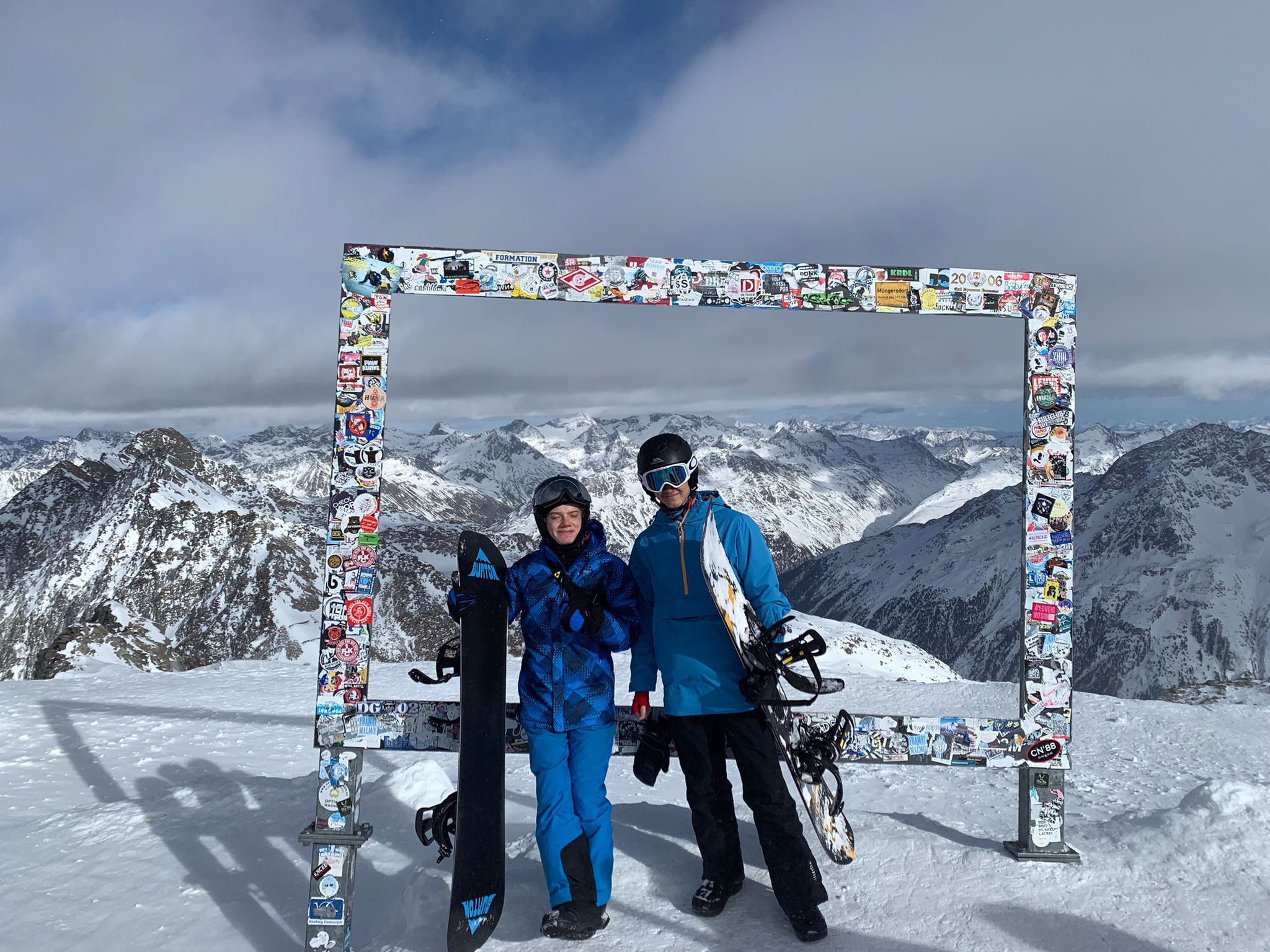
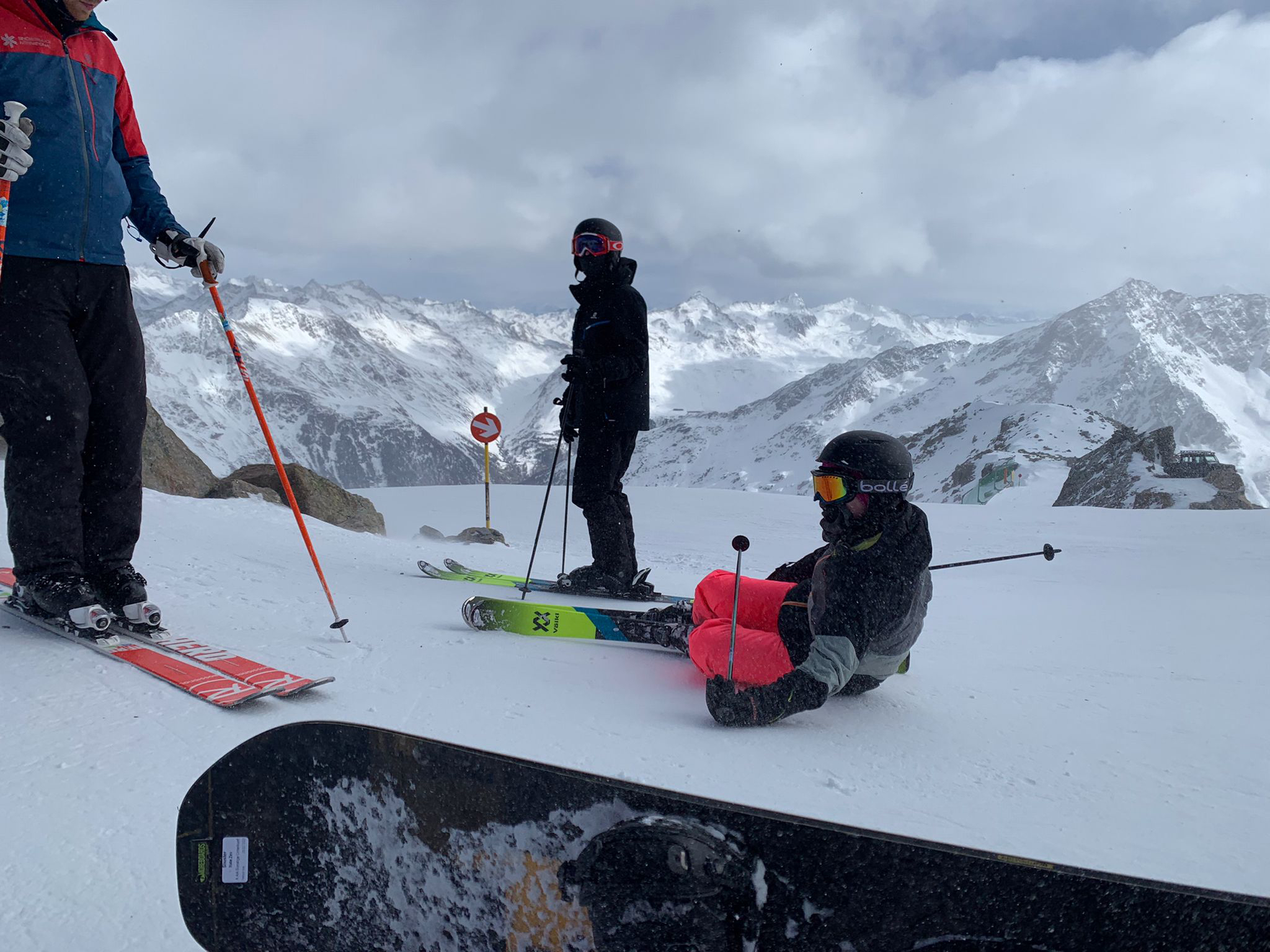
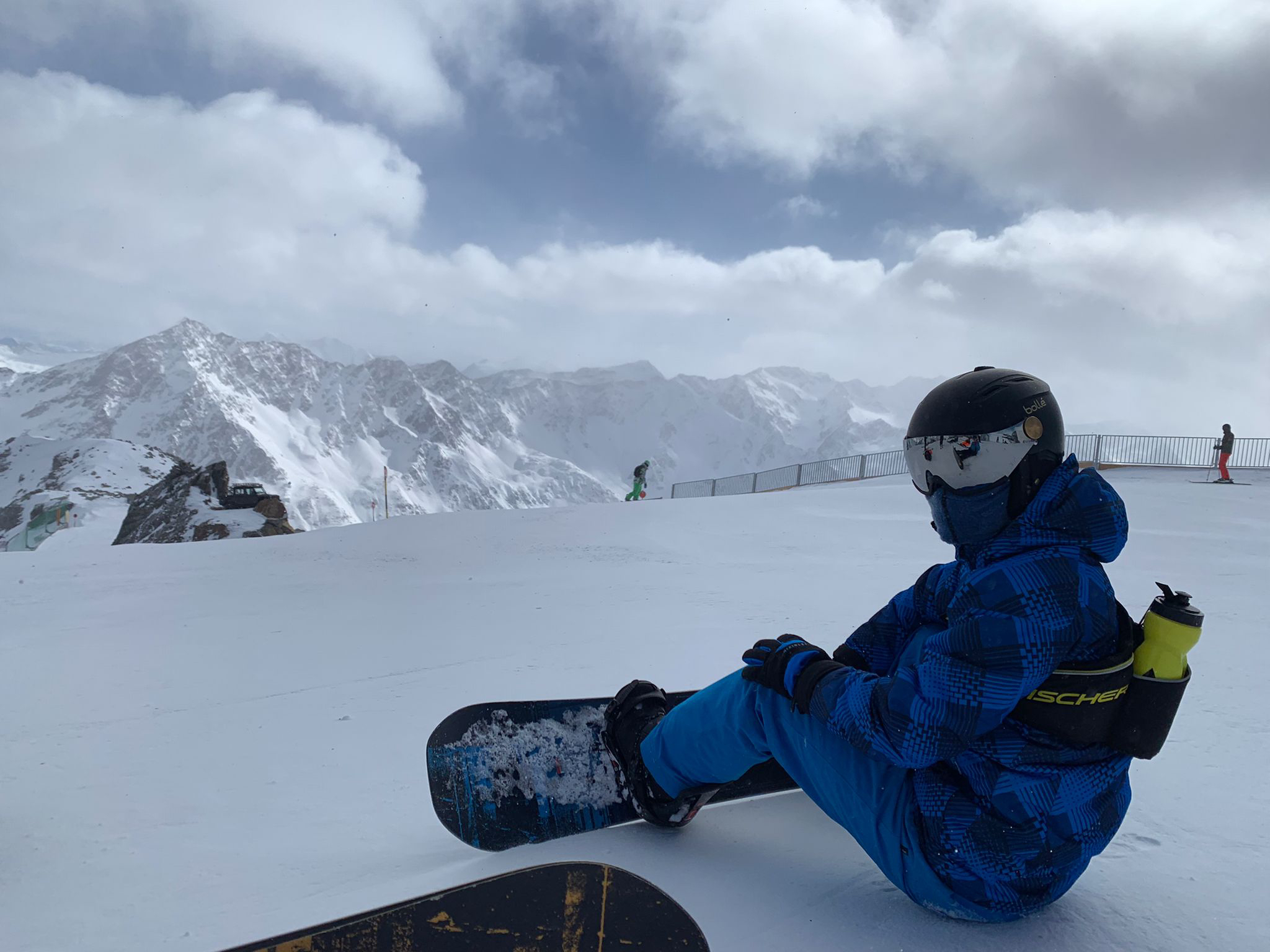
On the slopes in Soelden, Austria

By Doug McIlwraith, Director of Music

On the first Saturday of half term there was a truly awesome sight to behold at the North Terminal of Gatwick Airport: 37 Bedales families ready and waiting for the first Bedales ski trip for several years and the first major school trip since the start of the pandemic.

Staff, parents and Claire De Menezes from the Health Centre had worked incredibly hard to ensure all COVID requirements were met, which included 34 PCR tests, 37 slightly different COVID vaccination status reports to be checked and numerous letters from doctors proving recovery. It took a little longer than usual to get through the airport but we all relaxed a little more as we got through every checkpoint and finally arrived at our destination in Soelden, Austria.

The final COVID hurdle was surmounted when our COVID passes were used to activate the ski pass! Once on the slopes, we enjoyed a week of amazing snow and some very fine weather. The instructors were impressed with the level of skiing in the Bedales group and great progress was made throughout the week. Our guides from Snowtraxx stayed with us in the hotel and students got to know them very well, which helped with lessons and building confidence. The students were clearly quite taken with the awesome surroundings and the thrill of skiing with their friends. It almost felt like getting back to normal life and we look forward to more school trips and adventures! Watch this space for information on forthcoming ski trips which are generally advertised 10 months in advance.

My personal thanks must go to Ruth Austen, Ana Simmons, Clive Burch and Shaun Ritchie who accompanied the students and also to the parents who supported the trip and went the extra mile to ensure everyone was COVID compliant. Personally, I had a blast and was super impressed with the skiing from all groups.

Outdoor Work hosts Small Shepherds’ Club

By Kirsten Houser, Assistant Farm Manager

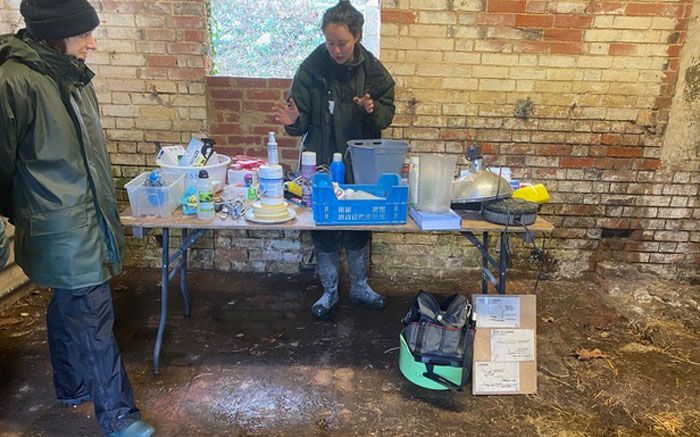
In the wake of Storm Eunice, we were very happy and surprised to welcome over 30 visitors, head-to-toe in waterproofs, to visit our lambing shed on a grey and rainy Saturday afternoon. ‘Preparation for Lambing’ is an annual event run by the Small Shepherds’ Club, a fantastic organisation providing practical help and advice for small scale sheep keepers in the southern counties. Each year a different shepherd hosts the members, some new to lambing and others with years of experience under their belts, and this year Bedales was asked. The aim of the event is to demonstrate our system for managing the lambing shed, equipment we have on standby, essential bits and bobs to make lambing life easier and lessons learnt from our years of birthing baby sheep!

The joy of an event like this is that knowledge is shared so generously between members, and it provided a great opportunity to reflect on how we lamb here at school, and also gave us a gentle nudge to get everything tidied up and organised ready for the first of our 20 ewes to give birth after half term. Outdoor Work students did a fantastic job clearing out the Black Barn and making up pens in the maternity suite, and we received many compliments on the farm and surrounding school estate – even in it’s post-storm raincloud.

We discussed lambing bag essentials (prolapse spoon anyone?!) and the importance of colostrum in the first few hours of a lamb’s life, heat lamps, ewe nutrition and the many many uses of baler twine. We showed off our ‘lambing board’ – a dizzying chart of numbers and notes on an old whiteboard – not high tech but indispensable for keeping note of progress with lambing, any sheep who have needed assistance or medication and anything else to keep an eye on. The afternoon was topped off with cake and tea in the Outdoor Work barnyard, and a display of student work, knitted and woven items from the flock’s wool, and a tour of the spinning room. 

Over the next couple of weeks Andrew and I, along with our students, will take turns to watch over the flock at night, during the day and at dawn, and we take great pride in sharing what we do with visitors inside and outside of the school community. Lambing is easily the most exciting time of year for us on the Bedales farm, and though it is undeniably stressful and tiring, it never fails to be magical as well. Look out for an article in next week’s Saturday Bulletin from our BAC students, with news of all the new arrivals, including baby goats and surprise quadruplet lambs!

Supporting refugees – we need your help

By Rob Reynolds, Director of External Relations

With many Ukrainian people fleeing the horror and danger caused by the Russian military invasion of their country this week, the Bedales community is coming together to offer practical help to them and other displaced people in two key ways – and we need your support with these:

  • A collection of essential items to deliver to Ukrainians arriving in Poland
  • A day dedicated to supporting refugees next Tuesday in partnership with the Rural Refugee Network

Collection of essential items

We are contributing to a collection being delivered to Ożarów, Poland near the Ukraine border. The following items are particularly needed:

  • Adult clothing, toiletries (shampoo, conditioner, shower gel, soap, toothpaste, toothbrushes, deodorant, sanitary wear, toilet rolls)
  • Children’s clothing, pants, socks, nappies, toys, baby wipes, talcum powder, dummies 
  • Blankets, towels, sleeping bags, roll mats 
  • First aid supplies such as paracetamol, plasters, bandages

Please drop off donated items to school receptions as soon as possible. Our first collection of goods will be this Sunday, which will enable delivery in the region 24 hours later. We will then arrange further regular collections as necessary. 

Bedales has links with the Ożarów community through our own staff. You can read more about how they are supporting refugees here.

A day of support for refugees – Tuesday 8 March

Bedales holds regular community days when members of the school community work together to make a tangible difference to other people’s lives. It is timely that next Tuesday’s Powell Day is dedicated to the Rural Refugee Network (RRN). The RRN has supported refugees arriving in the UK from Syria, Sudan and Afghanistan, and it is currently calling for the government to offer a safe haven to people from Ukraine, whom they are poised to support. 

Our Powell day comprises:

  • Talk from Gulwali Passarlay about his year long journey from Afghanistan to the UK  
  • Syria to Steep walk in a day – students will walk a 12 km circuit in Queen Elizabeth Country Park with their tutor. Collectively we will cover the 4,000 km distance from Idlib to Steep – there’s still time to support the campaign by donating here.
  • Art Sale – A fundraising sale of artwork from established and emerging artists in the Quad from 6-9 pm. Please come along and buy on the night. Book your free ticket here.

Thank you for your support.

Music competition success

By Doug McIlwraith, Director of Music

Two of our hard-working musicians have won through to the final rounds of some prestigious music competitions. Elliot Cundy (Block 3) recently competed in the first round of the Royal Academy of Music’s Junior Department Piano Competition. Elliot performed Chopin’s virtuosic Fantasie Impromptu and was placed in the top three and goes on to compete in the final in a few weeks’ time. This is particularly impressive given that the piano is Elliot’s second instrument after double bass! We wish him every success for the final and our congratulations for his success so far.
 
Block 4 student Shoshana Yugin Power has won through to the final round of the Winchester Concerto Competition with three other competitors. Shoshana (pictured above at the competition) performed on the flute and was the youngest of all the competitors. It is particularly pleasing that she is through to the next round as she was actually successful in 2021 but the final event was cancelled due to the pandemic. Well done to Shoshana for returning and earning her place in the final again.
 
Shoshana also won the Under 14 category in the Petersfield Festival Young Composer Competition with her piece Elemental Elements which she composed for flute and piano. It is a piece inspired by the chemical elements and reflects Shoshana’s fascination with science as well as modern musical techniques. The completion was judged by the composer Jonathan Willcocks who also happens to be a former Director of Music at Bedales. We are glad he had the chance to see that creativity is very much alive at Bedales and well done again to Shoshana for making the most of this opportunity.

BAC Scripted Performances – perspectives

By Hayley Cole, Head of Drama

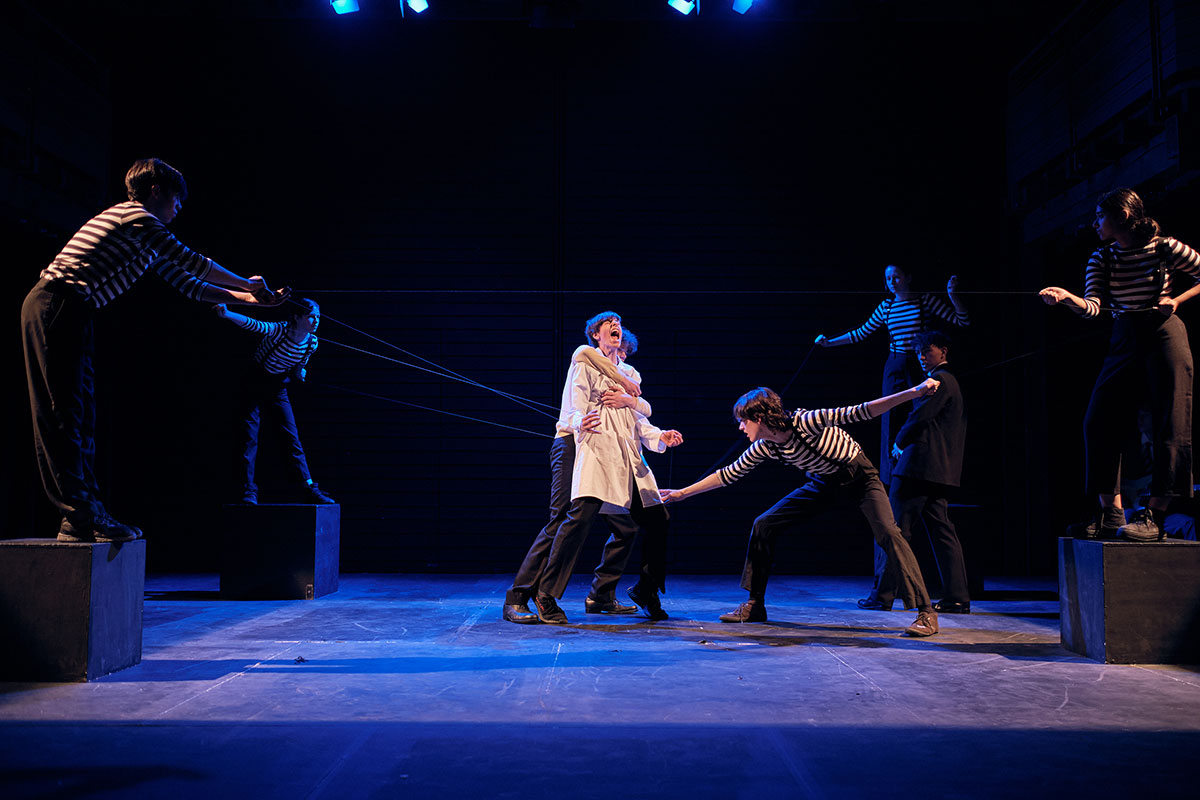
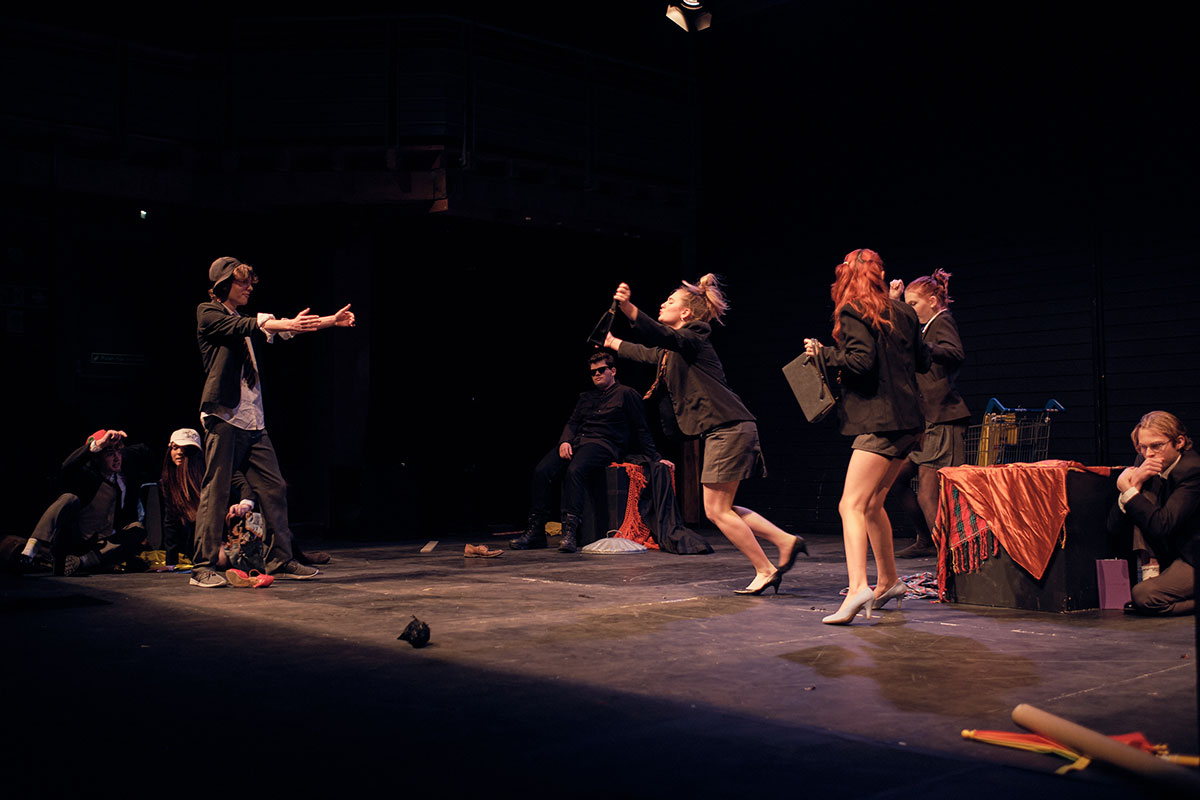
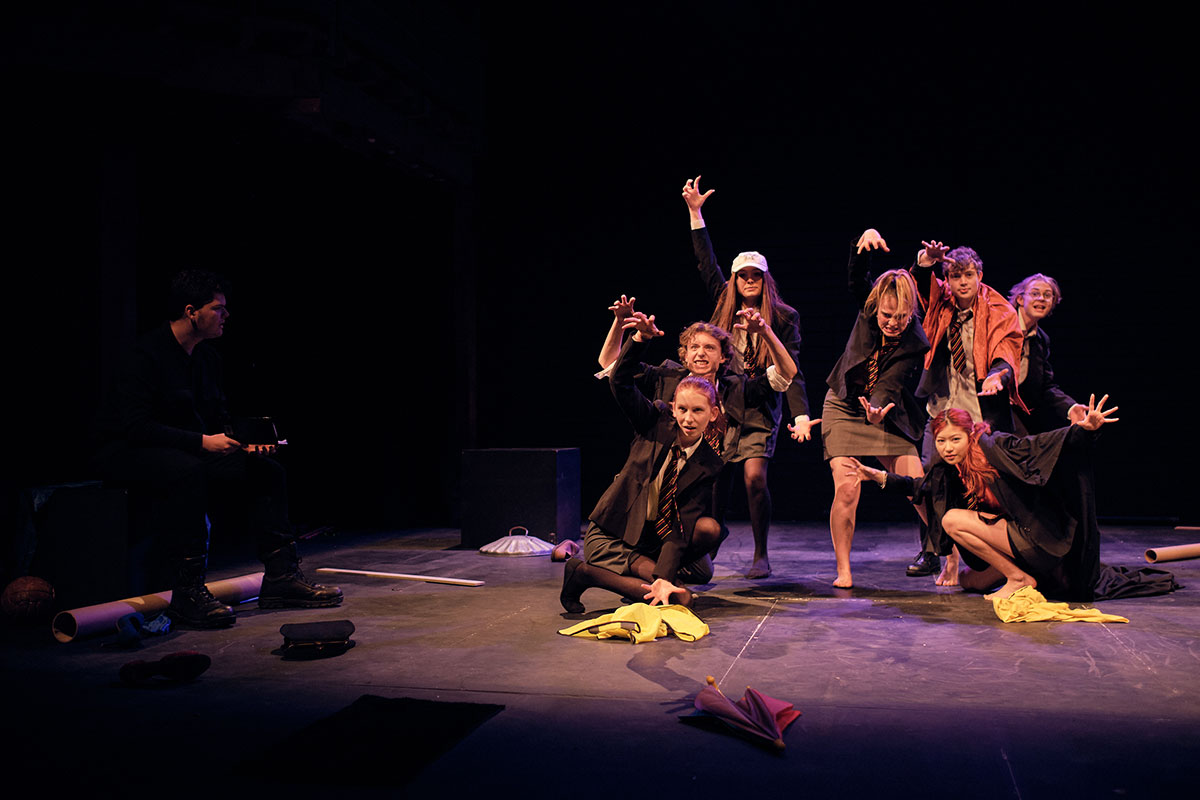
The BAC Theatre Studies students performed their scripted unit in the Theatre this week, which were enjoyed by audiences of family, friends, staff and the local community and examined by our two external moderators. They performed two comedies which were directed and rehearsed using the pedagogy of Jacques LeCoq. There was a wonderful audience response to the two plays and the students outstanding performances within them.


Craig Pullen, BAC Theatre Studies moderator: “On Tuesday evening it was an absolute pleasure to come to Bedales and moderate the wonderful performances from the Block 5 Theatre Studies pupils. The level of dedication and skill on display was a joy to witness. The performers’ adaptations of Lansley’s Flies and Ridley’s Sparkleshark were brave, well executed and had the audience in raucous laughter. Well done to everyone involved, I look forward to coming back to Bedales in the future.”
 
Chris Bott, Houseparent: “I have had the privilege and pleasure of watching a lot of scripted and devised performances in the Olivier Theatre, and although I know I am prone to hyperbole, I have every confidence in saying that Tuesday night’s performances were the most enjoyable entertaining ensemble work I have seen in the Theatre. The commitment, timing and energy of both groups was remarkable to see in students of this age and I haven’t enjoyed an hour in the Theatre as much in years. The best compliment I can pay is that with both groups the examiners both put down their pens half way through and enjoyed the performance like the rest of the audience, such was the quality of the show. Thank you and well done.” 


Peter Thackrey, Deputy Head (Pastoral): “Wonderful to see live performances again and to see some students who I never would have imagined blossoming in to such amazing actors when they joined us in Block 3!”
 
David Anson, Head of English: “What a brilliant evening! I thought both companies were incredibly tight both in their physicality and their voice work. Two genuinely funny pieces that genuinely lifted the spirits of the audience. Standout moment for me was Lilibet’s entrance; hilarious.”
 
Tristan Wilson, Head of Modern Foreign Languages: “Loved it! It was so great to see my tutees in their element and to see some very proud parents in the audience.”

‘Curtain raiser’ Dance workshop with Chhaya Collective

By Liz Wood, Head of Dance

Block 3 and 4 Dance students took part in a two-day workshop with choreographer and director of Chhaya Collective, Kay Crook. Kay worked very intensely with the dancers, giving them the experience of what it might feel like to be in a professional dance company and the students rose to the challenge. They were then fortunate enough to perform the piece they had learned and created as part of the curtain raiser for Chhaya Collective’s performance in the Theatre last week. Here are some comments from the students who took part. 

By Phoebe Land, Block 3
This was such an interesting experience because we were introduced to lots of different styles of movement. In the first day we learnt the first phrase, which was choreographed around animals, and this was especially interesting for me, as I haven’t done a lot of proper dances with a storyline. Kay mixed the Block 4s with the Block 3s to create individual duets, with different parts of the music. Kay made sure everyone was happy with the movements and showed us how to execute them to make us look professional. Then on the second day, we learnt the next phrase which was the opening movement. This involved two different hand gestures, which were later used again in the Bharatanatyam by me, Biba, and Annabel. This was so fun, and everyone really enjoyed it! 

By Milly Trench, Block 4
Kay worked very well with us to create the curtain raiser for us to perform. We started off by doing an intense warm up which was a great taster on their style and how we were going to be dancing for the next two days. I thought this was great because it allowed us to warm up how the professional dancers do and experience a higher level of intensity. We were taught the movement but were given sections to work creatively in groups to add to the overall performance. We were also asked to choreograph duets with an animalistic style and a connection with your partner. 

By Biba Hardy, Block 4
Throughout the workshop we were given different creative tasks where we were able to use our own ideas in sections of the dance. One task that we were given was to make a duet – we were put into pairs and each pair was shown a video of other dancers doing a duet to gain inspiration from their piece KHAOS. Each one was slightly different and had different techniques that were used in the duets. None of them were the same, but all of them had some things in common, for example they were all quite animalistic and used a lot of eye contact between the two dancers. Once each pair had watched the dance that their duet would be inspired by, we all had some time to think of new moves and ideas, while also incorporating some of the moves from the sections of the dance that everyone had been taught in unison. Each pair had a section in the dance to perform their duet one at a time, so that everyone’s ideas could be seen.

By Sophie Lee, Block 3
Kay taught us about a side of dance I haven’t come across before. She lived in India for a while, so she taught us some dance moves from Indian culture. The Indian style she focused us on was Bharatanatyam and she taught us the unique hand movements. There were two main phrases she taught us and they were in her own style. She focused in on specific movements, making sure we all were making them very sharp and clean. She split us into two lines and showed us how to effectively be in sync with our line but also mirror the line opposite. By letting us choreograph a duet after a day of working with her, we found that we were all heavily influenced by the new dance moves we were introduced to, and with Kay’s help we made the duets in a different style than we normally would.

Chhaya Collective review

By Mathilda Douglas, 6.2

Last Friday, Chhaya Collective came to Bedales to perform their amazing dance performances HYMNOS and KHAOS as part of the Bedales Events programme. Chhaya Collective are a female-led dance company working between UK and India. Their company was founded by Kay Crook in 2013 to engage artists in cross-cultural collaborative performance and creative projects, in response to societal issues. Their performance strives to amplify women’s voices and share real-life stories of women in the 21st century. In their performance they combined dance, music, theatre, and visual arts. There was a live band on stage which included a violinist, percussionist, and guitarist. 

HYMNOS was inspired by the story of Iranian artist and friend Saba Zavarei and her online platform Radio Khiaban, dedicated to Iranian women singing in the public spaces of Iran, an act currently forbidden by the state. HYMNOS was in the form of a duet, one woman relating to a traditional Iranian woman in society and the other woman was the Wild Woman. The Wild Woman was showing the other that it was acceptable to break from society and wanted to show her how to do it. They did this by the use breath within their flow of movements. They used contact to travel around the stage which helped opened each other up. Their movement got wider and more expansive as the piece went on, which showed the journey of breaking away from society. They used found sound and voice, where both women would either be screaming linking with the lighting in the piece or singing melo notes connecting together as one. It seemed the screaming linked with the feeling of annoyance towards the Iranian government and how their rule of singing in public shouldn’t be allowed. 

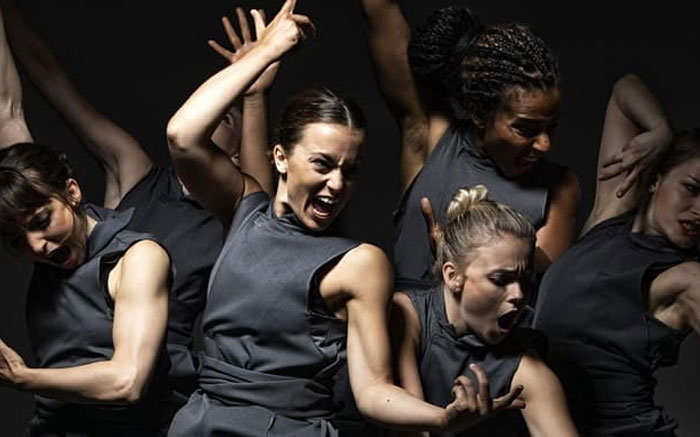
KHAOS describes itself as “not neat, nor calm, nor perfect, but vibrant, chaotic and powerful – we are wild 21st century women. We are not to be gazed upon but met head on”. This quote was their subject matter for their piece which celebrates what it is to be a woman. The live musicians join six contemporary dance artists to revel in the joy, tenderness, and the power of wild women. During this piece, there was direct correlation between the dancers and the musicians. Every time the musicians would increases or decrease their sound/intensity the dancers’ movements would get bigger or faster or decrease and become slower.

In the first part of this piece, all the women were dressed in grey coats that were tight fitted, showing no flaws of their body. There was the main female who would be controlling the other women, to show them how women are pictured/presented. They showed how women should always be perfect and should not expressed any feeling/emotion. They always had to have their arms by their hips in a fist shape and chins up. When travelling around the stage, they had to shuffle their feet in small movement to show control within their movement and there was very little dance material happening. At one moment, they were all trapped in a small circle centre stage where they all had a centra poised feeling towards them. Once the women knew how to hold themselves properly, it became harder to maintain this position as they all got very tired, proving it difficult for the leader who was controlling them.

At this moment the music stopped, and all dancers fell to the floor, the sudden silence showed that the women were tired of trying to be perfect all the time and this feeling had to stop. The violinist woke up the dancers and they took their grey costumes off to reveal bright/vibrant patterns. Once their realised that they could be whoever they wanted to be and show their true feelings they started to accept one another. They performed free flowing movements in a circle to unite everyone together. The music grew and their movement became more expressive. They performed a series of jumps with the use of breath which showed the women accepting themselves and showed their true colours. They started to scream to show their happiness with the accompany of the fast-beating music and overall had a high energy to end the performance.