Visiting Thomas Hardy’s Wessex – perspectives

ezgif-2-9ddd9f52b528

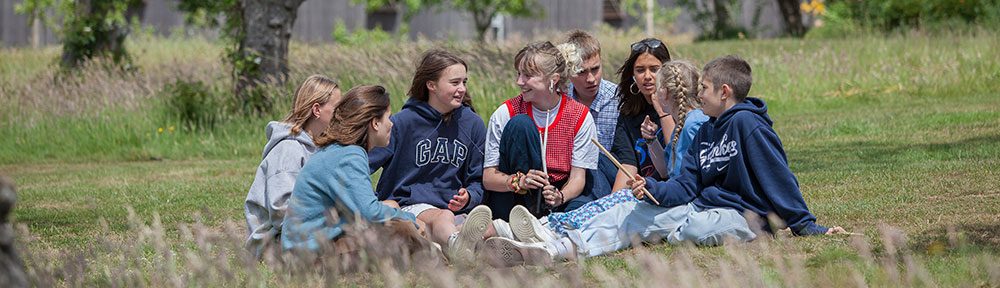
On Tuesday, 6.2 English Literature students went on a trip to Dorset to visit some of the key sites in Thomas Hardy’s life, to complement their study of Hardy’s 1841 novel, Tess of the d’Urbervilles, as well as some of his poetry.

The group visited Hardy’s Cottage in Higher Bockhampton, where Hardy was born, grew up and wrote his early novels, before going onto Stinsford Church, where Hardy’s heart is buried with his first wife, Emma Lavinia, and walking across the River Frome, across which Angel Clare had carried Tess in Tess of the d’Urbervilles.

The group also visited Max Gate, the atmospheric Victorian home which was famously designed by the author and remained his home until his death in 1928, before hearing from two English Literature PhD students, Laura Cox and Sophie Welsh, about Hardy’s work. Here, some students share their perspectives from the trip.

image5

Oscar Clark: Sinking into Hardy’s armchair by the fireplace he designed, tiled by ceramics he found, surrounded on three sides by the privacy of a screen that has stood since he sat there and looking at a mirror upcycled by the man himself, I listened to Neill, the National Trust volunteer guiding us through our visit to Max Gate. A scholar on all aspects of Hardy, Neill showed us the humourous, sensitive and at times difficult man, as well as the nuances and foibles of his personality being reflected in the features of the home he designed.

Isabella Doyle: My favourite moment from the trip was seeing Hardy’s Cottage, where he grew up. I learned much information from the guide who showed us around Hardy’s former home. She explained how Hardy’s mother had strongly advised her five children not to marry, and Hardly was the only one who went against her advice – twice.
Continue reading

UKMT Intermediate Maths Challenge success

Maths

By Martin Hanak, Head of Maths

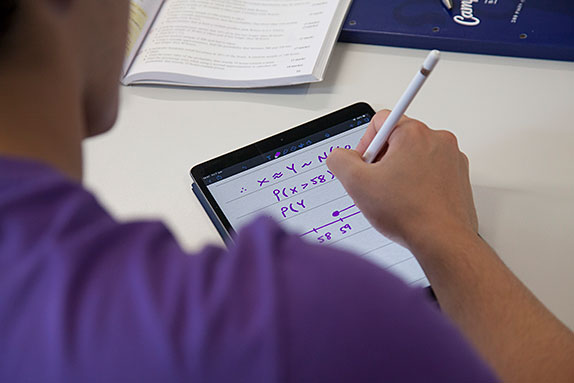
Every year around 200,000 students from the UK take part in the UKMT Intermediate Maths Challenge and the top-scoring 40% of participants are awarded Bronze, Silver and Gold certificates in the ratio 3:2:1. This year, 72 Bedalians were among the participants. Congratulations to the students who were awarded certificates, listed below:

Block 3: 7 bronze and 3 silver certificates

Bronze: Candice Kamal, Joe Cullen, Rafael Legorburu, John Hall, Katharine Cecil, Meiya Feng, Reuben Stannah

Silver: Archie Holmes, Dylan Hui, Izzy Land

Block 4: 13 bronze and 5 silver certificates

Bronze: Daisy Taylor, Mike Wei, Ben Greening, Connor O’Donoghue, Nate Shuster, Beatrice Lingham, Pim Rippinger, Anna Anikieva, Arlo Martin, Jac Wheeler, John Wentworth-Stanley, Teo Sydow-Elias, Rowena le Poer Trench

Silver: Renee Luo, Benjamin Tsang, Gabriella Stephenson, Chubbs Bailey, Coco Witheridge

Block 5: 3 silver and 2 gold certficates
Silver: Zakhar Gabriadze, Adam Forsyth, Raef Macnaghten

Gold: Annabelle Snell, LJ Phelan Continue reading

Outdoor Work hosts Bedales’ first ever ‘forge-in’

By Iris Campbell-Lange, 6.1

Outdoor Work is unique in its ability to displace us from the normality of walled classrooms. It enables everyone, regardless of age, to become acquainted with the work that our hands can miraculously create.

On Saturday I, along with seven other keen blacksmiths (who are either learning blacksmithing as part of their Outdoor Work BAC, have chosen blacksmithing as an enrichment or regularly attend blacksmithing club with our visiting resident blacksmith, Lucille from Little Duck Forge), diverged from the routine of morning lessons and attended Bedales’ first ever ‘forge-in’. A forge-in is the term given to a group of blacksmiths working collaboratively on a project – and in our case, we spent the day making a decorative panel for a new wooden archway to be built at the entrance to Outdoor Work near Steephurst.

Continue reading

Psychology Crime and Deviance Conference

Psychology-conference

By Eliza Goodfellow, 6.2 and Psychology Don

Last Tuesday, the Psychology department welcomed Andrew Lewis and Allan Walker, a convicted murderer and fraudster, to talk about their experiences with the UK’s criminal justice system and life with a criminal record as part of our Psychology Crime and Deviance Conference. They were accompanied by a forensic psychologist who has worked with psychopaths. Her role plays a part in the process of assessing whether prisoners will be able to function adequately if integrated back into society, without posing a threat to the public.

The criminal justice system was outlined to us, and we were given a scenario to discuss whether we thought the man involved was guilty of murder. It came as a surprise to us that the murder we were discussing as a group was in fact the lecturer’s trial – it was at that point that he revealed he was a murderer. The majority of students believed that in the scenario described, Andrew was innocent of murder, guilty primarily of grevious bodily harm (GBH) in an act of self-defence.

Continue reading

Belarus Free Theatre visit

Belarus-Freedom-Theatre

By Livi Grout-Smith, Oscar Clark and Amber Pearson, 6.2

Last Wednesday morning, we were lucky enough to be visited by Natalia Koliada (Director) and Sophie Robins (Head of Communications) from the world renowned theatre company Belarus Free Theatre (BFT).

Created in Belarus in 2005 as an underground theatre company and having to perform in secret locations so as to protect themselves from prosecution from the Russian and Belarusian governments, BFT’s directors, Nikolai Khalezinm and Natalia Koliada, were forced to move to London to escape further persecution and have since directed their actors in rehearsal via Skype calls between London and Minsk. Having chosen the company as the inspiration for our final 6.2 devised piece, we had never thought we would ever get to meet one of them, let alone have lunch with them, as we did during their visit.

Continue reading

Recreating ‘The Eve of St Agnes’

3

A Level English Literature students were transported back in time on Monday when they took part in a practical exercise designed to reinforce their understanding of one of the course’s key texts – The Eve of St Agnes by John Keats – following the success of last year’s experience day centred around the same poem. 

The Eve of St Agnes, which is set in the Middle Ages, was inspired by the legend that unmarried women could see their future husband in their dreams if they performed certain rituals on 20 January, the evening before the feast of St Agnes.

It follows the young maiden Madeline as she escapes a loud and festive family party to go to her bedroom and perform the rituals, hoping to see her lover Porphyro in her dreams, despite being from opposite sides of two rival families.

Madeline does see Porphyro that evening, but her dreams morph into reality as her lover – having snuck into her room while she was at the party – emerges from his hiding place in the closet and attempts to rouse her by laying out a feast and playing the lute.

To bring them closer to Keats’ poem, 6.2 English students were asked to work in groups across two classes to produce tableaux representative of the poem. They sought the help of the school’s costume department to find appropriate attire and recreated the scenes in various locations – including the Lupton Hall, the sand quarry and All Saints Church in Steep, with some venturing as far as Midhurst.

Continue reading

English students exercise persuasion skills in homework debate

By Lucy McIlwraith, Teacher of English

This week, my Block 4 English set were given the chance to debate a subject close to the heart of every member of the school community: homework.

Having learnt about persuasive devices and studied speeches from speakers as diverse as Donald Trump and Greta Thunberg this half term, students have made their own speeches to their class on a wide and eye-opening range of topics. Kipp Bryan had researched fast fashion and advised us all to buy more from vintage clothes shops; Theo argued for a ‘back to basics’ approach to paying footballers; Stella Miller gave an illuminating account of what it has been like to be without a smart phone for the last month and how liberating it has been; and Masha Kulakova argued for more languages to be taught to primary school children. Having practised their skills as solo performers, the class moved on to a more tricky way to persuade an audience: team debates.

Continue reading

Bedales Physicists visit CERN, Geneva

CERN-trip

By Anthony White, 6.2 and Physics Don

On 24 January, 6.2 Physics students were fortunate enough to travel to the largest laboratory for particle research to date – the Conseil Européen Pour La Recherche Nucléaire (CERN) in Geneva. It provides physicists with the ability to accelerate particles to approximately 1.08 billion kilometres per hour, while then observing the results of their collisions.

The first day saw us visiting the Red Cross Museum, an exhibition dedicated to the international humanitarian organisation that brings relief to people in the event of war or natural disaster. In the evening, we visited the History of Science Museum in Lake Side Park. On display were over 800 instruments, mainly used by Swiss scientists, dating back to the 17th century.

Continue reading

Weekends at Bedales

Star-Wars-lego

By Tom Batty, 6.1

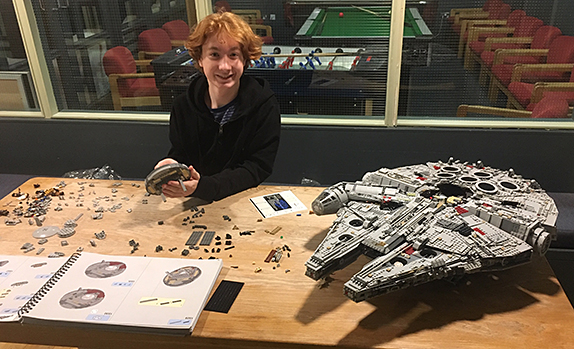
In between finishing off prep, helping with a refugee charity and hanging out with friends, I built every Lego fan’s dream, The Collector’s Edition Star Wars Millennium Falcon, which was kindly gifted to the students of Boys’ Flat at Christmas.

After my morning lessons on Saturday, I – along with significant help from history teacher and house parent Chris Bott, as well as Block 5 student Teo Sydow Elias – set to work on unboxing and starting the build. We started at 1pm on Saturday and worked until late into the evening, stopping only for dinner.

My help on the project was halted on Sunday morning by an early start for some volunteering work with the Rural Refugee Network, as organised by Al McConville. I and several others helped set up and martial their Walk for Hope, a charity walk that raises money to help support Syrian refugees in the UK. Fellow 6.1 student Eloise Cooper helped man the drinks stall at Elsted Village Hall for another fundraiser, which included raffle tickets, cakes (courtesy of Outdoor Work) and drinks as ways to raise money. There were several touching speeches from founders of the charity and also some of the people who they have helped arrive and settle in the UK.

Continue reading

Bedales sheep bring victory

IMG_0201

By Andrew Martin, Head of Outdoor Work

On Saturday night at the Small Shepherd’s Club AGM, Kirsten Houser and I were the proud recipients of the McLellan Lambing Trophy (pictured above with Etty and Sasha). The trophy is awarded to the flock with the highest lambing percentage. Although we came second in 2018, in 2019 we were finally victorious!

Here in Outdoor Work, we have a long tradition of keeping sheep. We mostly have Jacobs, a breed prized for their piebald fleece and magnificent curly horns. Not only do they have a distinctive look, they are easy to handle and produce delicious meat. Because of the variation in their fleece, the wool is highly sought after by knitters and weavers.

We also have three smiley-faced South Down ewes. This is a local breed that has grazed the South Downs for centuries and is historically one of the most important British sheep breeds. Keeping them company are two Herdwicks, a breed native to the Lake District. We mostly keep them just because they look so awesome!

Continue reading